Treehouses Of Irian Jaya.
Treehouses Of Irian Jaya
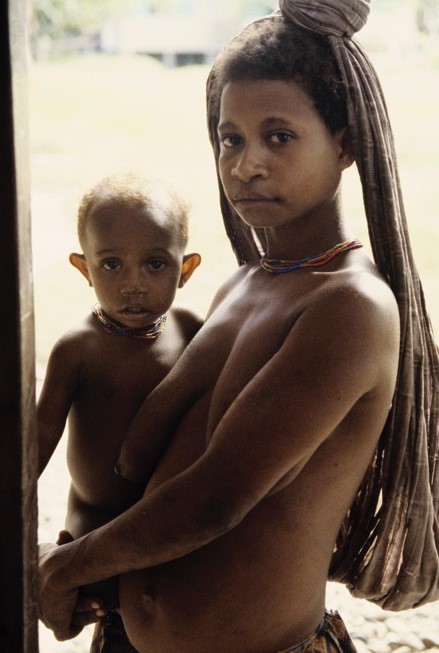
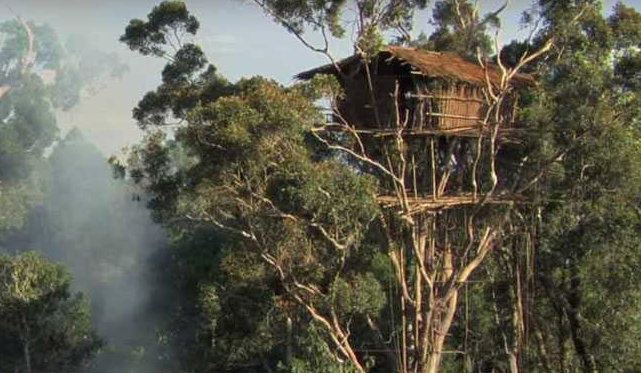
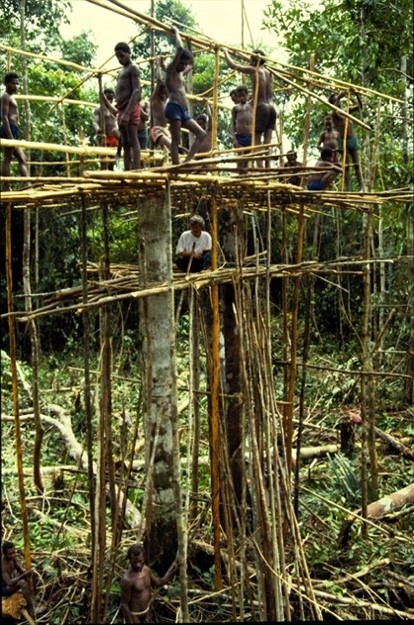
We went to film the Korowai, one of the last tribes on Earth still living without electricity, cars, or much contact at all with the outside world. Our job was to capture their way of life – especially how they built treehouses 40 feet above the jungle floor, using nothing but handmade stone axes.
There was no script other than a rough outline. Just the unparalleled opportunity to witness something rare and extraordinary – as if we’d been handed tickets to a living museum, a chance to step back ten thousand years in time and observe a way of life untouched by modern distraction or noise.
Our job was to follow Smithsonian anthropologist Paul Taylor into the jungle and document the building of a treehouse – crafted entirely with stone tools, lashed vines, and centuries of tradition. His job was to try and understand how this society worked, without judgment or exploitation.
The pressure was on for us to make a good film: The Smithsonian Institution had partnered with Hearst Entertainment to launch what they hoped would be the first in a new series of highbrow adventures for television: Smithsonian Expeditions. Where science and story meet. Cultural insight with a splash of thrill.
And so, with permission slips from the Indonesian government, dozens of cases of camera gear, and snakebite kits packed just in case, we headed off – into a world where the rules were different, and the trees grew taller than belief.
Back in our modern existence, we know the world is round. We’ve seen photos of Mongolian falconers, skyscrapers in distant Chinese cities. Even if we never visit them, we know they exist.
But what do the Korowai know of our world?
Their world is a rainforest. They still use stone tools. They must assume the jungle goes on without limits in every direction. Maybe they’ve seen a plane pass overhead once or twice: a shiny bird? A god, maybe.
But once we arrived – descending from the sky like Martians in boots and vests, carrying cameras and strange machines – they’ll know for sure: there’s something else out there. Something beyond endless jungle.
UP THE RIVER
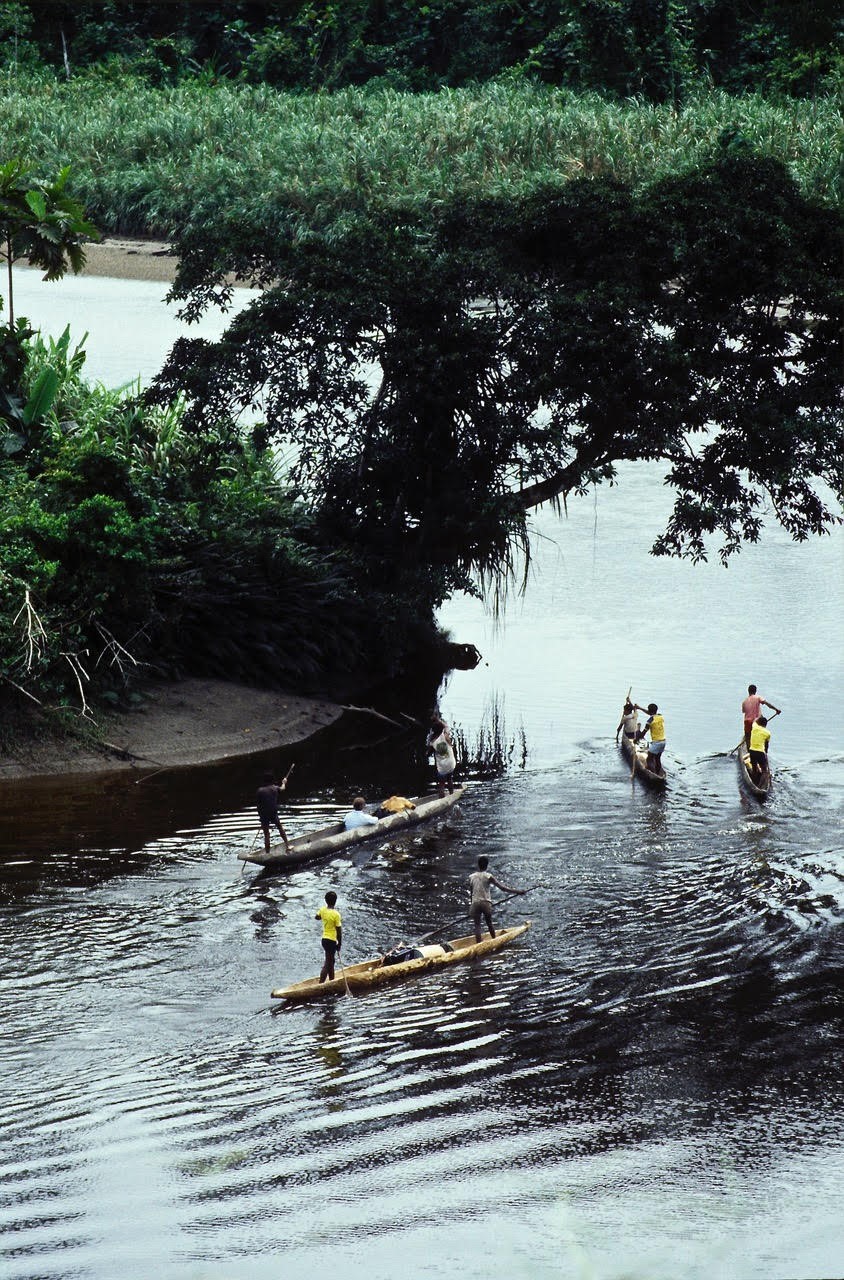
We pushed off at first light – local pilots, porters, crew, a scientist with his assistants, and a live chicken. Dugout canoes were packed with gear, including a fifty-kilo bag of rice. And we headed up the Darum Kaibur River. Text me if you can find it on a map.
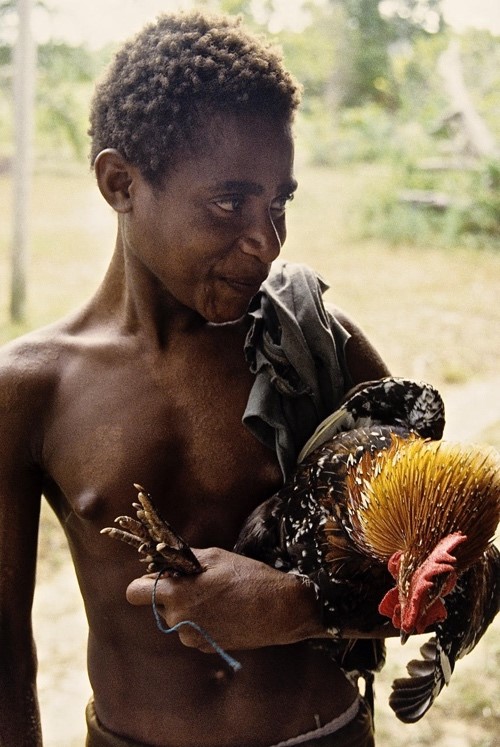
One man cradled the chicken in his lap. Another had a machete tucked into the waistband of his shorts. Behind us: the last outpost of anything resembling a town. Ahead: two days of river and jungle, mud to the knees, and a destination so remote it barely had a name.
There were no roads where we were going. No stores. No second chances. Just dense canopy, rain, more rain, and a people few outsiders had ever seen – the Korowai.
THE FARTHEST I’VE EVER BEEN
Preparing for a trip like this meant more logistical planning than any other project I can recall. The effort is summed up in three concepts: “No roads. No rules. Rain.”
To take on a film like this, I knew I needed my most road-worn, unflappable crew – people who could handle heat, bugs, soaked boots, logistical chaos, and long stretches without coffee.
First call: Rich Confalone, my longtime camera assistant, a magician with both gear and heart. He always knew where everything was: “The small screwdriver set that …?” “Case 14, left pocket.” He said before I could finish the sentence.
Then Richard Kane, a sound recordist so precise he could’ve been a neurosurgeon. I trusted him with my life, and certainly with my audio.
And of course, the person who brought me into the adventure: Judy Hallet, my dear friend and colleague, the producer behind the film. Judy and I had worked on several films together, including a
beautiful portrait of Gauchos in Argentina that was nominated for an Emmy for Cinematography. She has a rare gift: no matter how complex the shoot, she remained generous, clear-eyed, and patient – always encouraging moments of beauty to find their way into the frame.
In her role as producer extraordinaire, Judy started on the details six months ahead of time. Just getting film permits from Indonesia took someone on the ground in Jakarta three months to obtain. Judy generously invited me to co-direct with her in addition to shooting it. I was happy to share that role – and maybe lift some of the weight she was carrying as the expedition’s engine and compass.
SOME OF WHAT WE BROUGHT WITH US
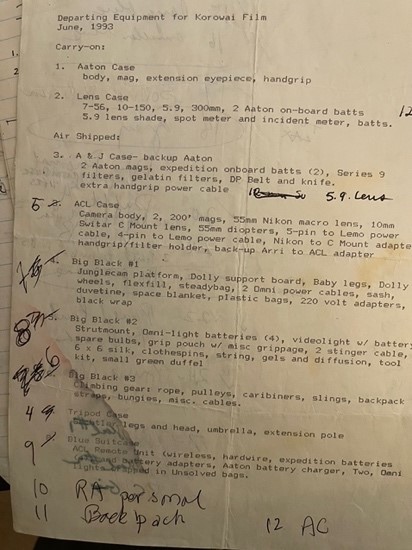
This above list – one of dozens – is a glance at how we tried to prepare for the unknown. Stained and probably re-written three times, it tracks just a sliver of what we hauled: cameras with backup cameras, lenses, power cables, snakebites kits, spare batteries for the spare batteries.
There were no stores where we were going, and no Amazon drop off by drone. Just us, the gear, and the faint hope that “Case 14, left pocket” held what we thought it held.
Travel light? Not this time.
I was aware of the irony. We brought the whole modern world on our backs… just to witness a world that had never needed any of it.
Getting There
- We flew from D.C. to LA
- Then to Hawaii, with an overnight layover there.
- Next, Biak, Indonesia -- six hours on the ground
- Then a connection to Jayapura. Another overnight.
- From there, Wamena -- and a small missionary plane, waiting with our hired cook already on board.
- One more layover.
- And finally, a flight to Yaniruma: a Dutch missionary outpost that now served mostly as a muddy airstrip and launch point into the jungle
- Dugout canoes
- Walking in rainforest.
Picking up the journey
From there: the aforementioned dugout canoes, torrential rain, mud to the knees, and two days hauling gear through rainforest with no visible trails.
Every step raised a question. Would the gear survive? Would we? Would the treehouse construction actually happen? Would they let us film it? Would this ever end?
But what we couldn’t see – what really got to us at the time – were the roots.
Twisted, hidden like a network of living tripwires, I’d place a foot down thinking I had ground, only to slip or jam a toe into something submerged.
More than once, I reached for a branch, only to grab thorns or fire ants. I put on gloves but the thorns went right through them.
Every few steps, someone stumbled. Every few minutes, someone cursed. It felt like the jungle was reaching up from below, testing our balance – and our nerve. Remind me why we came here.
Whenever we asked Jacob, our guide, how much longer to the treehouses, he’d just point to the tops of the trees – indicating, I later realized, where the sun would be when we arrived. Pretty good system. Who needs a watch?
Once, he pointed low on the horizon indicating that we’d get there late. I made an exaggerated face,
imagining we’d be walking in the dark. Being near the equator, sunset was always around six. Jacob
just laughed.
Field Journal
Layover, Biak
Another stop. I’ve lost track.
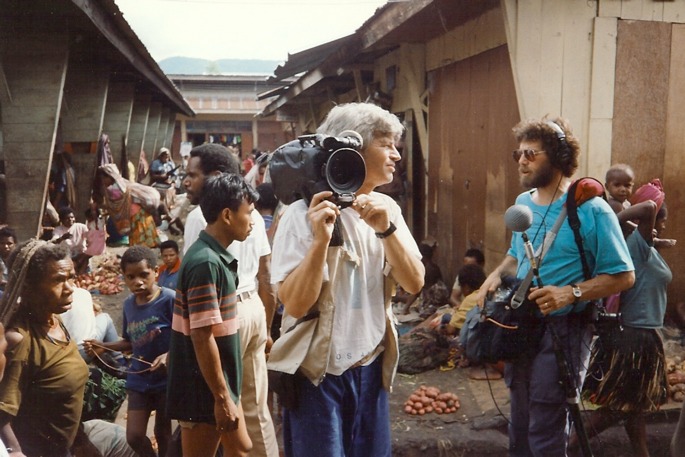
We found a market near the hotel-open-air, full of color, voices, fish, fruit, baskets, boots, heat. I could spend a lifetime in markets like this. Dick and I shot just to feel like we were doing something, I took a few photos, mostly to remember the light.
Everything smells like smoke and sea and ripe fruit. Somehow this feels closer to the story than any airport terminal ever could.
Still so far to go.

Jacob starts to explain – who we are, what we’ve come to do. They listen. No one seems alarmed. There’s a nod here, a glance there. Then silence again.
And finally, the question that’s on our minds: Where do we sleep?
Arrival
And then – suddenly – we’re there. The forest opens into a clearing. There’s just enough light left to
make out shapes. Huge. Looming. Magnificent.
Three, maybe four: The treehouse cluster.
Tall, spindly ladders reaching up into the night. I can tell there are more, further back there, partially
hidden by more trees. It’s quiet for a moment. Then movement. Slowly, they begin to descend – one
by one – climbing down to meet us. Or maybe just to watch.
Jacob starts to explain – who we are, what we’ve come to do. They listen. No one seems alarmed.
There’s a nod here, a glance there. Then silence again.
And finally, the question that’s on our minds: Where do we sleep?
Building Us a Hotel in the Dark
We needed shelter – something to protect us from jungle animals, insects, and the nightly downpours. It’s not like we could book six rooms at the Korowai Best Western.
Then something remarkable happened.
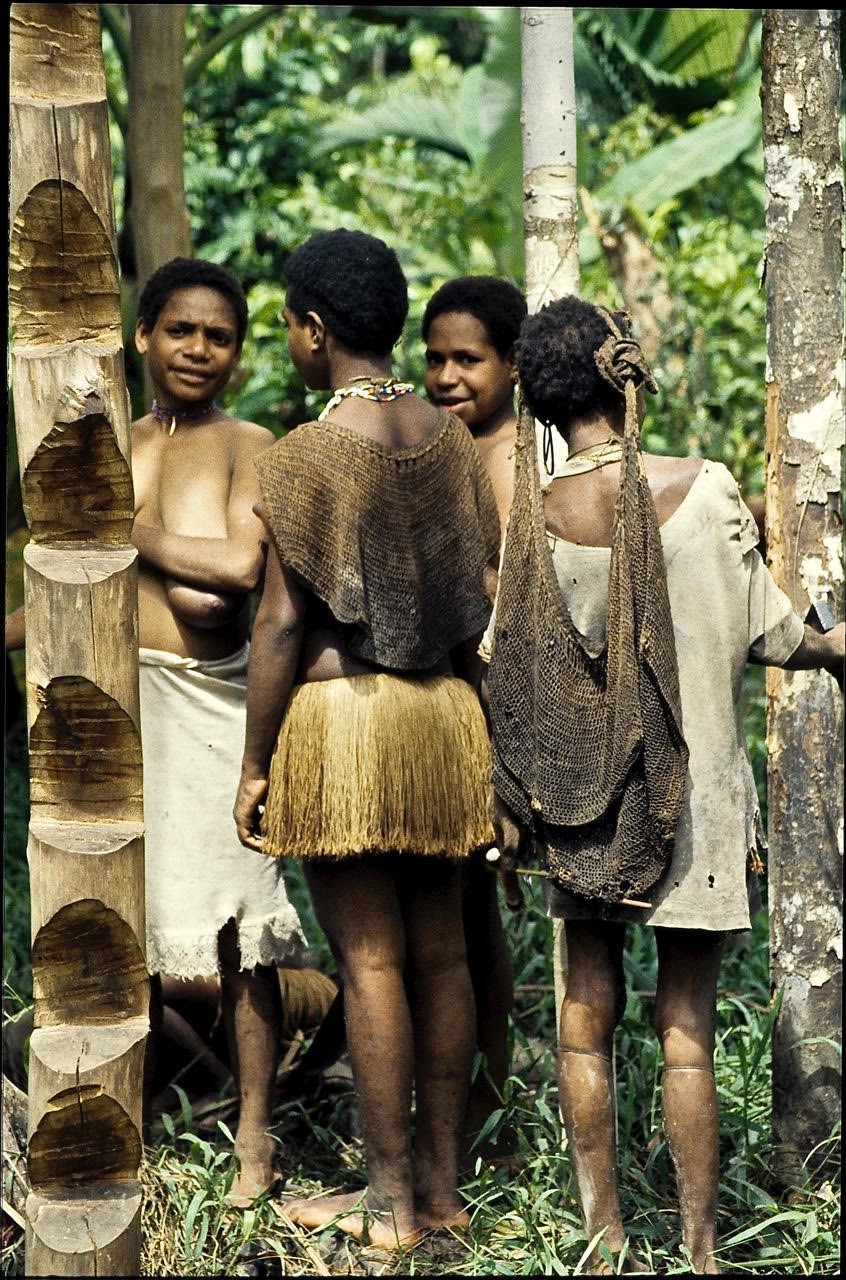
About twenty people started moving in sync. They began working in near darkness, moving with a kind of unspoken rhythm. It was like watching the Martha Graham Dance Troup. No one gave orders. Everyone just knew what to do. Some could be heard chopping in the forest. Others dragged palm leaves or long, flexible sticks toward the clearing.
They bent those sticks into the ground at intervals, arching each one until they met its pair, forming the ribs of a low-slung shelter. Then came the roof – layer after layer of broad palm leaves. Then a woven floor. Within two hours, they had built us a communal hut, wide enough for sleeping bags, low enough that no one could stand inside, but tight, dry, and solid.
And somehow – no leaks. Even under that night’s deluge.
Mostly dry. A few bugs. Some spiders. No TV.
They called us “Bapak-Bapak.” Honored guests.
We Were Home
One of my most vivid memories from the trip was lying in my sleeping bag, listening.
Above and around us, the Korowai treehouses came alive with chatter. Their voices rose and fell in the night air – calling across the canopy, trading jokes, stories, laughter. It reminded me of being a child, sneaking to the top of the stairs after bedtime, just to eavesdrop on my parents’ dinner parties. The clinking of glasses, laughter, muffled conversations drifting through the house – intimate and distant all at once.
I couldn’t understand a word, but the sound of their language was bright and playful. Almost musical. Not to sound disrespectful, but it reminded me a bit of the soft, wobbling cadence turkeys make -bubbly and animated. They called out from one treehouse to another, voices echoing in the dark, followed often by bursts of laughter.
I’m certain some of that laughter was about us.
About the strange visitors below, running around with black boxes on their shoulders, pointing them at everything. Our odd shoes. Our sweat-stained clothes. I think they took real joy in talking about us right in front of us – knowing full well we had no idea what was being said.
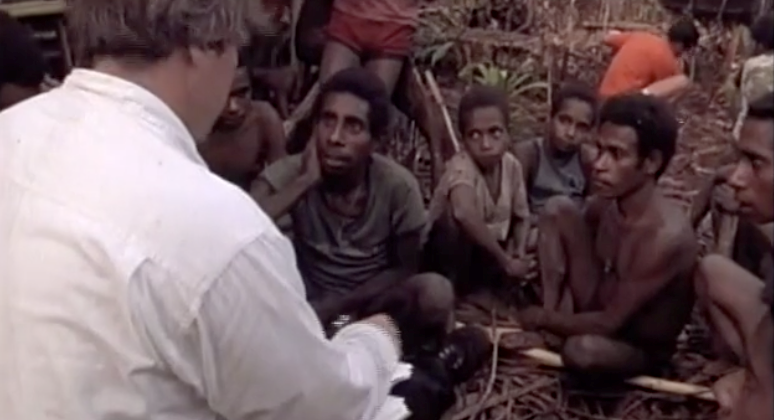
During the days, while we followed the construction of a treehouse from scratch, Paul, ever patient, would sit for hours with a few regulars, learning. They seemed to appreciated our interest in them. They taught us all their system for counting and how to name things. Paul scribbled everything down in a little notebook. The conversations went on for hours – about plants, insects, beliefs. About life.
We were Martians landed on a new planet, trying to understand every part of this alien world.
Judy kept a notebook of her own, writing each night no matter how tired we were. Here are notes for her own her soon-to-be-published book that captures what I’m only beginning to describe here:
Sapuru had an amazing knowledge of rainforest plants. He showed Paul which ones were used for arrow wounds, headaches, stomachaches, fevers – and which were part of magical formulas. One vine served double duty: it could tie treehouse poles together and cure coughs. Paul believed some of the plants Sapuru showed him might be rare species – maybe even a new genus.
Without the Korowai and their deep knowledge of the rainforest, visitors like us – modern, well-equipped, educated – wouldn’t have survived a week.
Cannibalism as Justice
There was another thread running quietly beneath the whole project – unspoken at first, but always there.
Back in the offices of the producers and executives, the buzzword had already taken root. Cannibalism. The rumors. The myths. The possibility. Some said the Korowai had practiced it. Some said they still did. It was discussed at our production meetings, and constantly hung in the air. Our film wasn’t just about treehouses and jungle rituals. This was television after all. And nothing sells like a forbidden glimpse into the dark corners of human culture like people eating each other.
Paul, ever the quiet student of culture, was the one most likely to uncover the truth.
What he found was far more complicated than we or anyone back home might have guessed.
To the Korowai, Paul discovered, cannibalism wasn’t random violence. It was part of their criminal justice system.
There were specific rules around it. Structure. Accusation. Judgment. Consequence. In our world, we might call it “due process,” though the ingredients differ.
There was a process. Then a ritual.
If someone was accused of being a khakhua – a witch who caused death or illness through spiritual means as an example – they were killed. And, yes, they were eaten. Not in a frenzy. Not for fun. But as a way of absorbing responsibility and restoring balance to the community. Restoring balance to the community: how profound.
That discovery reframed everything. This wasn’t savagery. This was a belief system, built on a worldview as coherent and moral to them as ours is to us.
But, try fitting that into a one-hour TV slot? Hell, just the getting-there part and the building of the treehouse was easily two hours long.
The Funeral
More than halfway through the shoot, one of the elders died.
We woke to the sound of wailing drifting from one of the nearby treehouses. During the night, Amodo—an elder—had passed away. For the Korowai, this brought mourning. For us, it brought an unexpected shift.
The bad news: all treehouse construction stopped indefinitely. The good news: we were allowed to observe – and even film – the funeral.
This was especially good news for Paul, who was eager to understand more than just the architectural marvels. He was after the human systems behind the culture. And here was one, unfolding in real time.
The building tools were laid down. Grief took over.
The ceremony began beneath Amodo’s treehouse. It bore little resemblance to what we’d call a funeral. If anything, it looked more like a courtroom. Relatives gathered in a rough semi-circle – some had traveled from the upper river Dayo, where tension already simmered between clans. And one by one, they stood to speak.
According to Paul, the Korowai believe that when someone dies, their face disappears. The gifts presented at the funeral – tobacco, tools, cloth – are given not to the deceased, but to the mourners, as a way of preserving the memory of the one who died. They are also a form of compensation. The more grief expressed, the more a person hoped to receive.
Each mourner had to make a public case – what their relationship to the deceased had been, why their loss mattered, and what they believed they were owed. If those claims weren’t honored, the consequences could be dire. Paul told us that if even one mourner left dissatisfied, there could be war.
One woman from a neighboring treehouse community stood out. She was furious. (or at least she played a furious woman on TV). She said she had been abandoned as a child by her father, the deceased, and now demanded restitution. There wasn’t much sympathy in the crowd. Still, her fury lingered in the air, and rumors began to stir about possible bloodshed between the two clans.
In a last-minute move, our crew donated Dick Kane’s small axe to help defuse the situation. It worked. Dick has never quite gotten over it. But we’re all still alive – so there’s that.
Later, we speculated that the presence of our crew, and especially the presence of the one actual policeman among us, might have helped keep things from boiling over. There’s some reason to believe the Korowai were aware of our role as outsiders and factored that into how things played out.
I’ve often wondered what the conversations sounded like between the various clans – trying to explain who we were, why we followed them around with strange black boxes on our shoulders.
We just don’t know what we don’t know.
Judy once reminded me of the time Paul sat flipping through a book of New Guinea birds with a group of Korowai. They gathered around, pointing excitedly at the images. Paul thought they were identifying species. But later he realized: they believed the images were a kind of menu.
The funeral scene became one of the most important in the finished film – and a perfect example of why we always save a few rolls of film for the unexpected.
It wasn’t a memorial. It was a trial. A negotiation.
No courts. No cages. But justice, all the same.
A Vision of the Afterlife
One belief we heard from a Dutch missionary who’d lived with the Korowai stayed with me. When a person dies, their spirit begins a journey along a jungle path. If, along the way, the trail is blocked by a fallen tree, it means the time is not yet right. The soul must wait.
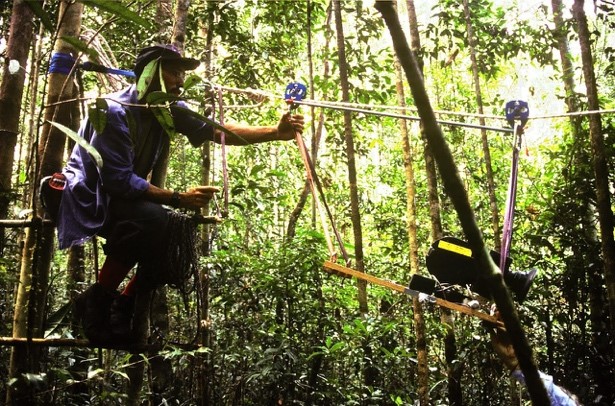
We tried to visualize this somehow on camera – quietly, respectfully – by rigging our camera into the trees, building a kind of low-budget sky rail using ropes and pulleys. We aimed to drift the lens forward, dreamlike, down a trail. The shot was bumpy and improvised, the jungle version of a steadicam on a prayer. But it made it into the film. Something about it worked.
Heart of Darkness.
As wonderful as these adventures are – with people from such vastly different worlds that I’ve had the honor to enter and observe – there’s always a touch of melancholy mixed in. I am always me, out here, watching you in there. It’s my job, I suppose.
And while each day is filled with flashes of connection – when we might, for example, burst into laughter at the same time, touched by the same moment – those flashes, though precious, are tinged with difference.
Maybe that’s just the nature of life.
At home, I find a similar kind of closeness with our cat, Luke, who curls beside me and purrs, seemingly safe in my presence. In those moments, I sense we’re sharing the same feeling of well-being. Maybe that’s as close as we ever get to the “other.”
It’s a sensation I’ve found in unexpected places – like that time I sat on the banks of the Amazon with a native boy who had probably never seen a white person before. We just sat there in silence, looking out over the river. And it felt enough.
The Francis Ford Coppola film Apocalypse Now was famously inspired by Joseph Conrad’s novel Heart of Darkness. Both suggest that beneath the surface, the difference between “civilized” and “savage” might not be so wide. That perhaps the jungle strips us down and reveals what we truly are.
Our journey – like Conrad’s and Coppola’s – took us up a remote river into dense, unmapped rainforest to film a tribe with virtually no contact with the outside world. But unlike Heart of Darkness, I came back feeling that Conrad got it wrong.
The so-called “savages” we met weren’t like us.
I thought they were actually better than us.
Just as smart. Just as creative. Possibly happier.
They may never write the Magna Carta or invent AM/FM radio. But neither will they poison their drinking water or pave over a forest for the sake of a parking lot.
Living beside them was unlike anything I’ve known. And while my job was to observe and document, I couldn’t shake the feeling – as always – of being an outsider. Like that Martian I mentioned earlier.
At home, we leave the sliding door of my closet cracked open because Luke likes to crawl in and curl between the shoes. Sometimes I watch him disappear into the dark, and I think I understand why he goes there – that sensation of safety, of shelter. And I feel close to him in that knowing.
It’s like that with the Korowai.
I can’t claim to fully “know” them. But I do feel that, in some quiet way, I do.
In the end, I didn’t leave with answers, or even much footage that could explain who the Korowai are. What stayed with me was the feeling of being close to something ancient and alive—a rhythm that reached beneath words, beneath culture.
Maybe that’s what documentary work really is: a long attempt to listen across that distance.
To see not just what’s in front of us, but what’s shared – the pulse of being alive in a fragile world.