The Butcher of Lyon wins an Academy Award
The Butcher of Lyon wins an Academy Award
Getting There
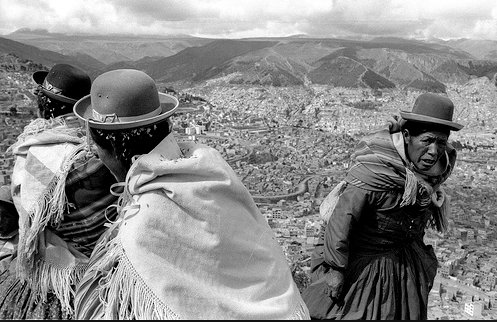
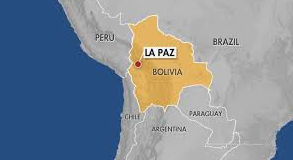
It was 4 am when we stumbled off the bus, shaken and sleep-deprived from the seemingly endless ride from Lima to the entrance of our hotel in La Paz.
What was promised to be a sit-back-and-relax kind of journey taking a day and a night of driving, became a nerve-rattling trip that seemed to take forever. It was probably good that it was pitch black outside the bus windows much of the time as it saved us from having to watch as our driver took the death-defying turns over those single-lane mountainous roads.
How do you say in Spanish, “Slow down that’s a 300-meter drop!”?
The drive to Bolivia was presented to us as a welcome opportunity “to rest and enjoy the dramatic mountain views” after a difficult week of filming in Peru trying to piece together a documentary film about an ex-Nazi named Klaus Barbie. Hearing of the drive, I immediately conjured up the image of a big Mercedes bus with all the trimmings: big collapsible cushioned seats for sleeping, individual focusable reading lights, and a clean bathroom in the back. Gullible me.
How do you say in Spanish, “Can you turn up the heat in this rattletrap?”
Our project, a feature-length documentary film directed by Marcel Ophuls, followed the 40-year-long search for fugitive and former Nazi SS Officer Klaus Barbie, known as “The Butcher of Lyon.” Barbie had been responsible for the torture and deportation of thousands of Jews, Communists, and Resistance fighters during the War from the headquarters he commanded in German-occupied France. After the war, Barbie escaped to South America as did many fellow Nazi officers. He came to live and work openly in Peru and Bolivia under the pseudonym Klaus Altmann where, in 1983, he was finally identified, captured, and extricated back to France for trial.
The big comfortable bus of my imagination would never have fit on the roads we followed. Every time the driver revved up the engine and shifted into another gear — which was continually — there was a loud grinding sound and a high-pitched engine noise that startled me out of the edges of sleep. Sleep might just have been possible if it hadn’t been for the non-stop blaring of what might be called “music” through the bus loudspeakers at a volume of +13. How do you say, “Please turn that shit off?”
Exiting the bus and taking my first steps in front of our hotel in La Paz, it hit me like a ton of bricks. I felt dizzy, my legs were wobbly, and my heart was racing. Oh, yeah. It was the Altitude.
I’d failed to remember before beginning the drive that La Paz was one of the highest cities in the w orld. It’s an impressive 13,500 feet high. The altitude hits people differently but almost everyone feels some version of strangeness.
There were five of us checking into the hotel. Pablo, a quiet-spoken soundman who joined us in Lima, Beatriz, a production assistant, also soft-spoken, also Peruvian who was hired as a translator, John,
The American producer, Marcel Ophuls, an Oscar-winning writer/director, not always so soft-spoken as you will see, plus yours truly.
Marcel’s earlier film, The Sorrow and the Pity about the French collaboration between the Vichy government and the Nazis during World War II is one of the most important documentaries ever made. In 1969, it won an Oscar for Best Feature Documentary
The Sorrow and the Pity blew a hole in the common, rather romantic notion that large numbers of the French had been active resistance fighters during the German occupation. Rather than being partisans, the film revealed that many had collaborated with the Germans, some turning in their own neighbors and families. The film was banned in France for many years because of its unpopular message.
The film had a powerful influence on me when I saw it. I took seriously the underlying message about the importance of individual responsibility. And on some level, I was worried that one day someone like Marcel or Ken Burns might make a film about the moral choices Americans – like me – made when it came to participating in the War in Vietnam. As a result of his film, I was moved to do everything possible to avoid participating in that war.
Now, almost 20 years later, Marcel was at it again with this new film about Klaus Barbie, an SS war criminal on the run. I was honored to be along with Marcel this time, to be up close and friendly to watch him work.
A DREAM COME TRUE
I never went to film school. I was still in the beginning stages of trying to teach myself filmmaking when a weekend with Marcel Ophuls was announced at The Institute For Policy Studies, a liberal think tank just three blocks from where I lived at the time near Dupont Circle in Washington D.C. How could I not go? He was already a kind of hero to me and there he was a five-minute walk from my house on R Street.
Marcel came across as someone who is a lot like his films; smart, angry, articulate, funny, ironic, and quick to call out people who abuse power.
I was riveted by Marcel’s presence. By his well-told stories, his focus on the human condition, and his unique take on the importance of documentary filmmaking as a tool for change.
After the second stimulating day-long lecture, inspired by his bluster, I summoned up enough courage and chutzpah to introduce myself to him as a working cinematographer. The claim was the epitome of cheekiness considering my embarrassingly limited experience at the time. I almost fainted a few days later when I got a call from the producer, John Friedman, wondering if I’d be interested in going to South America to shoot the first wing of their film about Klaus Barbie. I am still stunned by the shock of the call.
I knew they weren’t interested in me because of my glowing resume. I imagined they hadn’t yet raised much of their budget for the film, so my offer on the phone to “work for peanuts” certainly helped sweeten the deal. I’m sure it didn’t hurt that I offered to include my camera package and lights and that I spoke Spanish. Truth be told, I would have paid them to take me to South America and sit near to Marcel. Over the years, I never actually paid to be part of someone else’s film project, but I often worked for “peanuts” as a way to snag interesting-sounding films and gain experience.
Immediately after the call, I set out to teach myself everything I needed to know about being a cinematographer just in case they might hire me. I was sure they were actively looking for someone more qualified than me. I’m not sure I’d recommend it to others, but I learned an important lesson in How to Land the Job: Offer to Work for Peanuts.
I was fascinated by the project and naturally started asking them questions before they made any decision about me. I wondered, for example, how the on-camera interviews might be handled since Marcel didn’t speak Spanish. I offered to find them a good translator in Peru to make the interviews go efficiently. My genuine curiosity may have endeared me to them and increased my chances to becoming part of the crew.
SOUTH AMERICA
At the end of World War II, Barbie didn’t miss a beat. He picked up from where he’d left off as the apply-named “Butcher of Lyon,” applying his “skills” as a racist, torturer, and importantly, as an anti-communist in the new Cold War against the Soviet Union. In Bolivia, where he was openly hiding and where he lived for 30 years under that assumed name Klaus Altmann, Barbie was busy fighting communists all over South America, cuddling up to dictators, and purportedly helping to track down and kill Che Guevara.
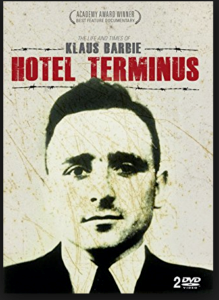
The irony wasn’t missed by any of us that during the time that we were preparing to film the back story to his life as a fugitive in South America, Barbie was sitting in a French prison awaiting trial in Lyon the city where he had set up his Gestapo headquarters during the war. When the film was completed, the title, Hotel Terminus: The Life and Times of Klaus Barbie, made the irony obvious to all.
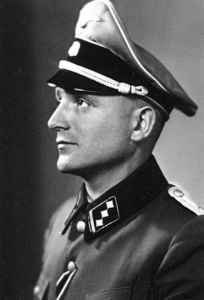
The Butcher Of Lyon
When Marcel began seeking support for the film, people would sometimes ask him, “Why Klaus Barbie?” — as if Barbie were a footnote in history, a minor Nazi. Marcel wouldn’t let that framing stand. He challenged the idea that someone needed to be famous to be held accountable. “How many people do you have to torture and kill,” he asked, “to be considered worthy of a film?” Barbie wasn’t obscure to the victims he interrogated or deported. As chief of the Gestapo in Lyon, he personally oversaw the torture of prisoners, the deportation of over 7,500 Jews and Resistance fighters to concentration camps, and the execution of roughly 4,000 others. His crimes weren’t symbolic. They were real and devastating.
What Is Your Name?
On the morning of day two, we met at the elegant Cafe de La Paz with Peter McFarren a local Associated Press correspondent. He would join our crew to help connect us around town. At the elegant cafe, a favorite hangout of Barbie, Peter showed us his usual table where he’d sit with his back against the wall. Over breakfast, we discussed our first interview later that morning with Barbie’s long-time bodyguard and business partner. It seemed the high altitude affected us still, adding a feeling of edginess. As much as I shouldn’t have had coffee, I ordered it anyway, unable to resist the beautiful café atmosphere with leather chairs and people smoking cigars.
After breakfast, we set up for the interview at our hotel with Alvaro de Castro in an adjoining room to Marcel’s. Castro was a tall, handsome Spaniard who seemed proud to have been associated with Barbie all those years. Right from the start, things got weird. Strange weird. Altitude-induced strange weird.
Most interviewer questions in most documentary films are either cut out entirely with the answers preserved or occasionally the questions are heard off-screen. Marcel brought an unusual style to many of his documentaries; he often appears as a character in them, a style picked up later by other filmmakers like Michael Moore. He likes to engage with the interviewee. In “The Sorrow and the Pity,” he is seen wandering around a garden, musing out loud as if to the cabbage, a bit like a detective in a film noir movie.
The English/Spanish/English interview process we came up with was a bit tedious and consumed a lot of film stock. Marcel would ask a question in English and Peter or Beatriz would then translate the question to Castro and then the process reversed with Castro’s answers being translated back to Marcel. Because sound was recorded separately from the image, we couldn’t easily cut on and off every time the translation was happening. The process wasted a lot of film with the camera running the whole interview. The advantage of shooting with video cameras would not be readily available for a few years.
While Marcel and Castro chatted before the interview began, I had a chance to adjust the lights, and we got a “head slate” to help with syncing the separately recorded sound, and we were off.
As someone who knew Barbie for many years, Castro was an important and unique interview for us. I was curious to see how Marcel was going to handle it.
“When did you first meet Klaus Barbie?” He began with a seemingly easy question.
Castro sat up in his chair, looking seemingly relieved that the question was an easy one. He paused and, with a bit of a smirk and a sense of “I’ve got this one,” said, “Well, I first met Klaus Altmann…”
Surprisingly, before he could even finish his first sentence, Marcel interrupted. “What is his name?” he asked, almost as if he hadn’t quite heard him correctly. Castro looked over to Peter who repeated the question in Spanish: “Cual es su nombre?”
“Well….” the bodyguard said in English with a kind of shoulder shrug.
As soon as he began again, Marcel broke in again, seeming almost to be mocking Castro’s casual tone and raising his voice just a bit. “Sorry: what is his name?
“Well…” repeated the bodyguard seemingly confused now but making me think he knew exactly what was going on.
I was growing more and more uncomfortable. I worried that Marcel might go too far, insulting Castro, and lose the interview.
Clearly to everyone in the room, Castro was referring to Barbie by his pseudonym, the name made up to disguise his real identity in his adopted country. Two different names by design, but the same person. Marcel wanted Castro to call him by his real name and he wouldn’t let up.
Castro was looking a little wounded. The altitude continued to raise the feeling of tension in the room among the rest of us.
“His name is Barbie.” Marcel said, now seeming to be helping Castro in a softer voice as if coaxing in a frightened animal.
Castro was silent now, slightly glazed over, seemingly confused by the focus on this apparent “tiny detail.”
In the pause, Marcel again asked “What is his NAME?” with a controlled intensity. I was beginning to feel light-headed.
Castro continued to appear confused but was curiously unshaken. He may have been working hard to keep his cool since he was getting paid for the interview.
“Now,” Marcel said, lowering his voice like a lawyer moving in for the kill, “Let’s start over. Tell me when you first met Klaus Barbie.”
Hesitantly like a 7-year-old trying to read a difficult passage in a book, “I … first … met … (he paused to think…then smiled, proud to have gotten the lesson correctly,) “Klaus … Barbie … in 1959.”
“Thank you,” said Marcel.
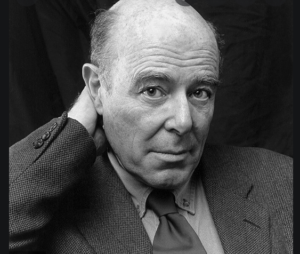
Marcel Ophuls
My legs were shaking from the intensity of the moment. I’ve been witness to a lot of interviews over the years with the great and the near great, but this moment was the most amazing.
Castro may have missed the significance of what Marcel was doing, but no one else in the room did. Marcel insisted that Castro take responsibility for the man for whom he worked all those years by getting his name straight. That was the first step.
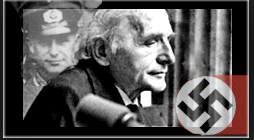
Barbie on trial in France
The 6 year-long story of WWII can be summarized as a series of battles in Europe and Asia in which the forces of good prevailed over the forces of evil. But just barely.
For many, World War II didn’t really end with Germany AND JAPAN surrendering as we like to believe. The American CIA moved quickly to protect Barbie and others. They gave him a new identity and employ his torture skills in the new Cold War.
It wasn’t until 1987, almost 40 years after the end of the war, that Barbie received the justice he deserved. He was convicted of Crimes Against Humanity and sentenced to life in prison, but he died of cancer after serving only 4 years. Barbie never admitted he was guilty of anything. Nor did his bodyguard who was barely capable of identifying his former employer by his real name.
I was born at the end of that terrible War and yet it seemed like a distant event told in old photos, history books, and films. But with Marcel helping to focus my attention, I could see the impact of the history in ways beyond the usual movies. I studied the images of Barbie on trial, in the same building where he’d tortured so many people and sent them to their deaths. Now and forever that image of a kind-looking grandfatherly person who perpetrated such evil while “just following orders” is burned into my memory.
In 1989, Hotel Terminus won the Cannes International Critics Award and the Academy Award for Best Documentary Feature. And Rotten Tomatoes gives the film 100%.