Man-Eating Tigers Make Us Question Honesty in Filmmaking.
Tigers In The Mist
The Road to the Sundarbans
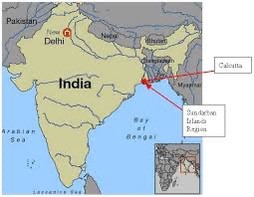
We’re driving in a small convoy from the Calcutta airport toward the Sundarbans, where our film begins. The road is chaos — horns blaring, trucks swerving, rickshaws darting into impossible gaps.
Rich, my friend and longtime collaborator, continually shouts from the back seat: “Wow! Look at that!” And he’s right. It’s one of those shoots where the world constantly demands your attention.
Every turn reveals something extraordinary: women in swaying saris balancing bundles on their heads, buffalo hauling wagons of firewood, a family of four crammed onto a motorbike, its horn locked in a permanent yap.
Widow Villages and Silent Tigers
We’re in India to film a project inspired by Sy Montgomery’s haunting book Spell of the Tiger. It tells the story of the “widow villages” on the edge of the Sundarbans — places where men who venture into the mangrove forests to fish or collect wood are often killed by tigers. These elusive predators swim silently through the brackish channels or lie in wait along jungle paths. What’s left behind are families marked by sudden, violent absence.
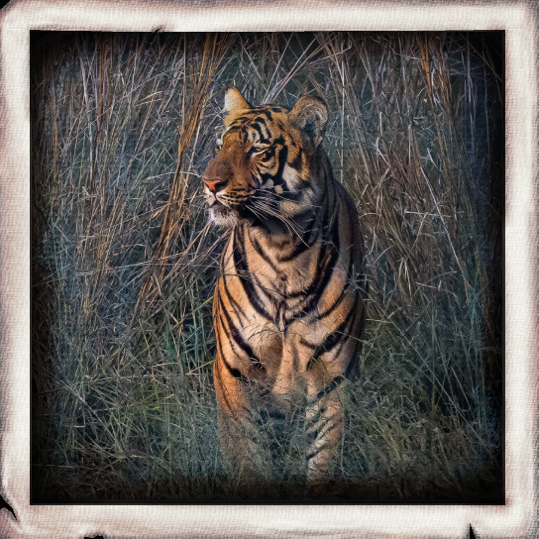
Sy had lived among these villagers while writing her book, and her return with us gave the community a reason to lower their guard. Her presence said, without needing to explain: These people are with me. In a place shaped by loss, trust is everything.
Waiting to Begin
When we arrived, there was still light. We set up beneath a banyan tree. Instead of jumping into interviews, I suggested we wait. I remembered a British filmmaker who once spent a full year living with the pygmies before shooting a single frame. That patience gave his work its depth.
The temptation is strong. It would be so easy to pull out a long telephoto lens and just hunt around for shots. Some of my best footage has come from that kind of random hunting—the people have no idea they’re on camera, so I’m able to capture natural activity and movement.
We didn’t have a year. But we had a day. So, we waited. And we watched.
Stories of Loss
The next day we set up in the same spot. The villager’s stories came easily. One woman told us how her son had vanished while fishing. Another spoke of her husband, taken by a tiger while gathering firewood. Their tone was flat, almost emotionless, but there was a gravity in the silence between their words. Grief lives there — not always in speech, but in posture, in the way children cling close to their mothers. It’s a language that escapes translation.
Being here, in a village shaped by loss, opened something in me. My father had died not long before
the trip, and I hadn’t yet found a way to make sense of it. Their stories stirred my own. I didn’t know
exactly what they were feeling—but I think I carried some of the weight with them.
The Ache of Absence
That night, I heard chanting rise from a nearby hut. I didn’t understand the words, but the sound carried memory. Not sorrow exactly — more like a prayer made of breath. I just stood there listening for a while.
Journal
The Riverbank Scene
The next morning, as we navigated the village’s narrow pathways, I caught sight of a group of women walking together, their vibrant saris catching the sunlight and fluttering in the breeze. It hit me as a kind of metaphor for life in the village, encapsulating the resilience and grace of these women.
Caught off guard, we weren’t ready to film it. By the time we scrambled to set up, the moment had passed.
Determined not to let such a lovely image slip away, we approached the women with the help of Soma, our production assistant from Calcutta. We explained our desire to film them and asked if they would be willing to walk along the riverbank for us where the natural breeze might nicely lift their saris.
The women exchanged shy glances. A bit confused, one of them remarked, “But we weren’t walking there before, and we wouldn’t be walking there now.” Another added, “We wouldn’t walk in that direction either — the sun would be in our eyes.”
Despite their hesitation, they agreed. We guided them to the riverbank with what seemed like the entire village following behind. After more confusion about where and how fast and more whys, they walked for us – self-consciously – but as we hoped, with their saris billowing in the breeze, creating a mesmerizing tableau.
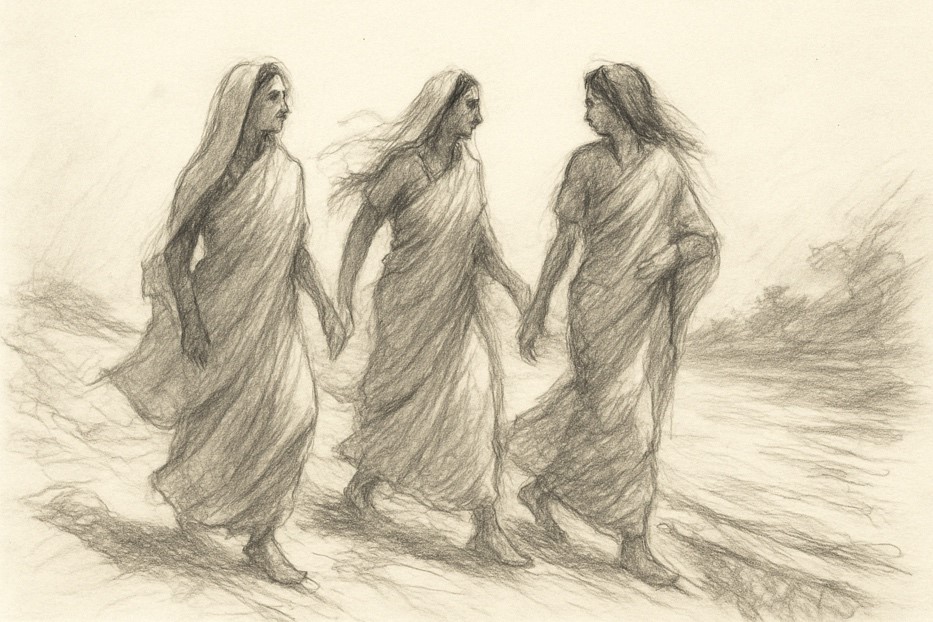
that the scene was worth the time and effort. The women and the whole village seemed to me to like the fact that we liked that moment so much. It helped draw us together. We convinced them to reluctantly try it one more time and this time, I shot it in slow motion. I hope
Later that evening, I jotted more in my journal that this shot might be worthy of opening the whole film.
The kind of suspended moment in the field that fills me with great joy.
Tracking Shadows
We’d go out early each day looking for tigers. Afternoons were for getting to know the village life, going out with the men collecting firewood, shots of the beauty that were everywhere.
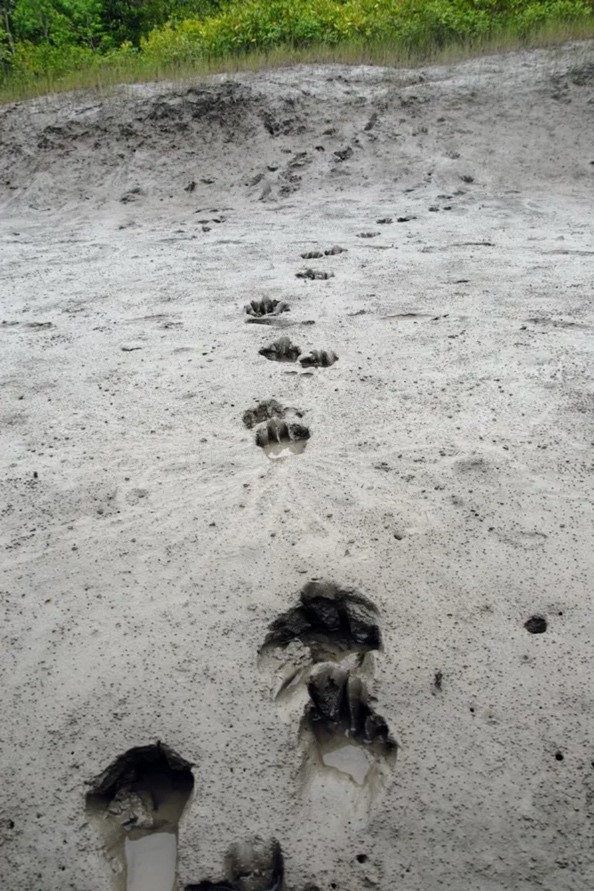
The tigers remained elusive. One morning, we followed fresh pugmarks—distinct footprints in the mud—that led us to the edge of a stream. There, we saw where a tiger had just crossed. We asked how fresh the paw marks were and our guide told us just minutes old. The proximity was both thrilling and frightening; we were so close.
Our guide, an elderly man with a rifle that seemed as aged as he was, accompanied us on these excursions. His presence was meant to offer protection, but the antiquated firearm and his frail demeanor did little to instill confidence. Still, his knowledge of the terrain was invaluable, and his stories added depth to our understanding of the Sundarbans. After more days of fruitless searching, we reluctantly made the decision to travel north to a reserve where tiger sightings would be more assured.
Journal
Finding Tigers Where We Might
After another few days, we say goodbye to the villagers and to Sy and head north to find some stand-ins.
And soon, there we are, bouncing along in our Land Rover along a dusty road in northern Kanah Tiger Reserve camera at the ready. Riding with me is the driver, who also serves as our tiger expert; Rich, the aforementioned camera assistant, still saying “Wow!” and my good friend, the producer Amy.
The landscape here is markedly different from the Sundarbans’ dense mangroves. Instead, we’re surrounded by dry deciduous forests, open grasslands, and scattered watering holes—terrain that offers clearer sightlines and, we hope, better chances of spotting tigers.
Our guide, a seasoned tracker named Arjun, shares tales of recent sightings and the behaviors of the local tiger population. His knowledge instills a sense of cautious optimism among the crew. As we drive, the anticipation is palpable. Every rustle in the underbrush, every distant call, could signal the presence of the elusive big cat.
The change in environment brings a renewed energy to our team. The challenges of the Sundarbans fade slightly as we focus on the opportunities this new location presents. Yet, underlying our efforts is a persistent question: are we somehow cheating by coming here?
We’ve gotten up with the sun for the third day in a row, hoping to see – and finally film – a tiger. By late afternoon, we still haven’t seen a thing. Just a few spectacular pug marks from the day before.
This kind of slow pacing would be usual if we were making a pure natural history documentary. But for the kinds of people-oriented films I usually work on — as is the case with this project — three days is already more time than we’d typically devote to filming “nature” alone.
But then, this is a film about tigers. So, we have to try to get something.
We’ve already gone through the coffee and sandwiches we packed at dawn. Now everyone’s a little munchy and more than a little anxious, wondering if we’re going to leave without seeing anything at all.
“Don’t worry a bit,” our overly enthusiastic driver keeps saying in a wonderfully strong Indian accent — a line he repeats every twenty minutes or so.
“Surely I will find you something today!”
His confidence doesn’t inspire much. It’s as if he thinks he can summon a tiger by sheer will. I start to imagine there’s a competition among these drivers — whoever gets the most sightings wins.
Non-fiction films are supposed to be truthful. About things that actually happen in the real world. But truth — not unlike those elusive tigers — can be a hard thing to capture on camera.
First, you’re required to know what the truth actually is. Then you must figure out how to film it. And even if you do shoot a scene that feels truthful in the moment — sometimes, when you get back to the editing room, it just doesn’t look right. It can fall flat. So you start stitching together pieces that help it feel authentic again.
That’s the dance. Trying to make the moment feel real – whether or not you captured it exactly as it happened.
Naturally, if we do manage to film a tiger, viewers will probably hear about how hard it was to get the shot. Even if — hypothetically — it turns out to be a tiger in a zoo.
Let’s say we do film one in captivity. We’d do our best to disguise the setting — no walls, no bars. Just the tiger. Shot in a way that makes it look wild. To some, that might feel like cheating. A white lie maybe. A sin of omission. But natural history filmmakers fudge the truth all the time.
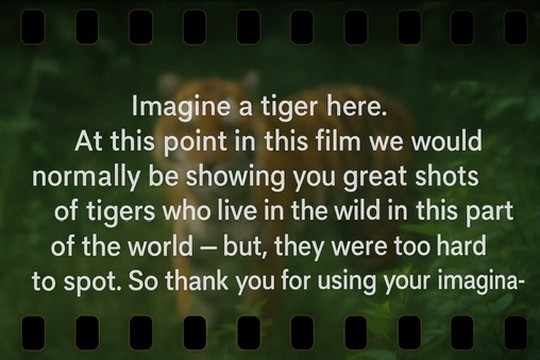
Suddenly, a note in the middle of the future documentary appears on screen:
So there we are, motoring slowly along in our Land Rover, stomachs growling and eyes glazed over. And, if we never see one at all? There is already serious talk about filming tigers in an enclosed habitat back in the States.
The natural history crews filming for the BBC Series Planet Earth, famously spent three years with a huge team just to capture a few rare glimpses of snow leopards on the Pakistan and Afghanistan border. Three years!
This morning’s drive follows two thinly visible tire ruts through some really beautiful, hilly, dense jungle. Dawn in the jungle is like nowhere else – filled with hoots, snorts, whistles, and wingbeats from hundreds of creatures not seen elsewhere.
In our zeal for tigers, we drive past all these other animals like tourists rushing through the Louvre – skipping masterpiece after masterpiece on the way to the Mona Lisa.
I have the camera by my side in my perch in the back seat of the vehicle, ready to film at any moment. But we see nothing and decide to head back to camp.
Back at the lodge that evening, empty handed, I opened my notebook. We hadn’t seen a tiger—not even close – but it hit me then: that wasn’t really why we’d come. The stories from the widows, the time spent sitting quietly in that village shaped by grief – that was the heart of it. That’s what stayed with me.
Our team had grown closer through the nature of the story we were telling, and I couldn’t quite believe we were being paid to travel to this distant place and share in the reality of such a beautiful experience. The tiger was just the reason we gave ourselves to go. What we found was something else. Something harder to name.