Heaven Drew Me In Part 2
Heaven Drew Me In Part 2
The Call from the Fog
Almost twenty years later a phone call reached me at a hotel in Italy, where I was on a shoot. I assumed it was my producer confirming our dinner plans.
It wasn’t.
“Hi, I’m calling from Terrence Malick’s production office in Los Angeles…
”Searching for Witt’s World
They were adapting the book The Thin Red Line, and Terry wanted a separate unit – independent from the main production in Australia – to capture images of the native people and landscapes of the Solomon Islands.
My possible job? To find people still living in their traditional ways, gain their trust, and bring back stunning footage of their world.
But no one could – or would – tell me what they actually wanted me to shoot. And I’d forgotten to ask on the phone. Even the script was mostly silent. Just a line: “Some soldiers go AWOL and disappear into local villages.”
Journal Entry-Milan, mid-morning
I stepped outside and stood in the shade, still holding the phone. ‘Malick?’ I mouthed. Like speaking the name out loud would pop the bubble. I thought maybe I’d misheard. But no. I hadn’t misheard. They wanted someone like me. To shoot. For him.
No Map, All Faith
From the moment I accepted the job, red flags started piling up. No one seemed to have answers. What exactly should I be looking for? Who’s managing logistics? Was I shooting this for the final film or just reference? Would I get help on the ground? Did we need permits? Releases? Food?
I started to realize why no one else was involved: it wasn’t in the script. The producers weren’t assigning time, crew, or resources because the script – the Holy Book of narrative production – didn’t mention any of it.
Chasing a Vision Without a Map
When I finally got my hands on the script for The Thin Red Line, I went searching – not just for direction, but for any mention of the world I was being sent to find. I looked for references to Solomon Islanders, to grass huts, to rituals or fishing or jungle life. What I found was… almost nothing. No scenes. No characters. No description of what, exactly, I was meant to film. Just a brief mention: some of the soldiers go AWOL, disappear into the local villages.
That was it.
But in the finished film, it’s not “some soldiers.” It’s Private Witt – the soul of the film – who breaks ranks and wanders off, drawn not by rebellion but by longing. In the opening scenes, he’s floating in a lagoon, laughing with children, gazing at a world that feels untouched by war. His absence isn’t defiance. It’s curiosity. A reaching.
And somehow, I thought, that’s what Terry wanted me to find. Not Witt, exactly – but the world that might have made someone like him hesitate to go back.
The Bird Calling
Before I even left the States for the scout, I tried several times to reach Terry by phone. I’d been hired to lead his small unit on his new film, this I knew. I was tasked with filming village life and native wildlife in the Solomon Islands – the “poetic imagery” that might run beneath or between scenes of war. But no one in production seemed to know what I was supposed to shoot. Or if they did, they weren’t telling me. From the beginning, I seemed like a thorn in their sides.
After several attempts to reach him, I reached Terry at home where he was staying in Queensland, Australia where they had already begun prepping and filming.
“Hello?”
“Hi Terry, it’s Reuben — the documentary filmmaker.”
“Oh, Hi Reuben! How are you?”
Then, abruptly: “Oh wait. Hold on for a minute.” The phone clanked on a table.
I waited.
In the background, I heard voices – some excitement. Then he came back on, slightly breathless. “Sorry — a rare bird just landed right outside the window. Wait just a bit more please.” So respectful, so thoughtful. The phone clanked on the table again.
More waiting.
Terry finally got back on filled with all apologies. He declared he’d seen some kind of rare species of bird outside the window where he was staying during the shoot. Don’t hold me to it but in may have been some kind of Kingfisher with a Buff-breast or something.
Of course that happened. Terry Malick, the mythic poet of cinema, interrupted our call to follow the sudden appearance of a bird. I couldn’t help but think it was a good sign. That somehow, I was now part of whatever else he was chasing.
I boarded the Qantas flight to Honiara via Auckland with high hopes. Finally, I thought, a chance to work on a major film. A big budget. A great director. A real team. All I had to do was find the images Terry might love.
But love, as it turns out, is hard to locate on a map.
Through the Fog
The problem was, that the world I was imagining he was imaging didn’t seem to exist anymore. At least, not in Honiara. Nor along the outside roads we scouted by jeep. The villagers we visited wore second-hand clothes and they had thatched huts but with corrugated metal rooftops. The “traditional life” Terry was hoping to capture had been paved over, quite literally, by progress and proximity.
I reached out to a few expats, even the local equivalent of the Peace Corps, but no one had much to offer. Then I came across a book about the Moro Movement, an indigenous community effort from the 1950s that blended spiritual tradition with political autonomy. I learned there might still be a village deep on the “Weathercoast” that carried on some of those values.
So I followed a hunch – not from the script, not from the producers, not even from Terry directly – but from the question his films always seem to ask: What if there’s still something sacred, just out of reach?
Journal
It led me to that story buried in a dusty bookshop to a helicopter ride along the misted coastlines of the Solomons. It led to a village that still held onto a memory of custom, still lived partly in that world the film’s character Witt longed for.
And it taught me something I’ve carried ever since: I don’t want to sound like Dorothy in The Wizard of Oz but it was that in the absence of clear maps, sometimes you just have to trust – and go looking for the answer on your own.
I did read the script and understood that the character Private Witt, played by Jim Caviezel, has gone AWOL from his Army unit and is living among a group of Melanesian islanders in what seems like paradise. He swims, plays with children, and observes a way of life that is calm, spiritual and in deep contrast to the brutality of war. Witt is set up as the film’s spiritual conscience, establishing a contrast between the natural world and human violence.
And of course, taking a cue from Days of Heaven, I knew what kind of beauty Terry wanted. And he clearly wanted someone out there looking for it – even if he couldn’t describe it, even if no one else thought it mattered.
I was used to working alone. But this was different. I wasn’t just chasing images. I was chasing a director’s instinct – across islands, across weather, across languages – without a map.
Journal
There were no roads to the Moro village. No easy path in. I imagined the only way there was by dangerous boat or to fly around the island by helicopter – below the fog line – just off the coastline, skimming tree canopies. With some help from the bookstore owner, I arranged for a chopper and convinced our reluctant liaison, Robert, to come with me.
The fog was so thick we never would have seen the village from the air if we hadn’t hugged the shore.
But we found it.
Scouting the Moro Village
Tucked along a narrow stretch of pale sand, partially hidden behind overgrowth, was the village. Makaruka.
The pilot brought us down gently onto the beach. The blades were still slowing when I stepped out. The air was thick – damp, salty, sweet with vegetation. About 200 feet ahead, a dense wall of green pressed against the beach. Trees, brush, vines – impossibly lush.
Then, from that tangled wall, all at once, a line of natives emerged from the brush – maybe thirty of them. They carried spears and shields. A few wore headpieces. They moved silently, shoulder to shoulder, with slow, deliberate steps.
It was like something from a movie. The movie we were supposed to be making. But now we were the ones watching in real time. It didn’t feel real.
Their menacing line was formidable but not that scary. Maybe because it was so surreal – too stylized, too composed. A picture from the past pulled into the present. I remember feeling more awestruck than anything else.
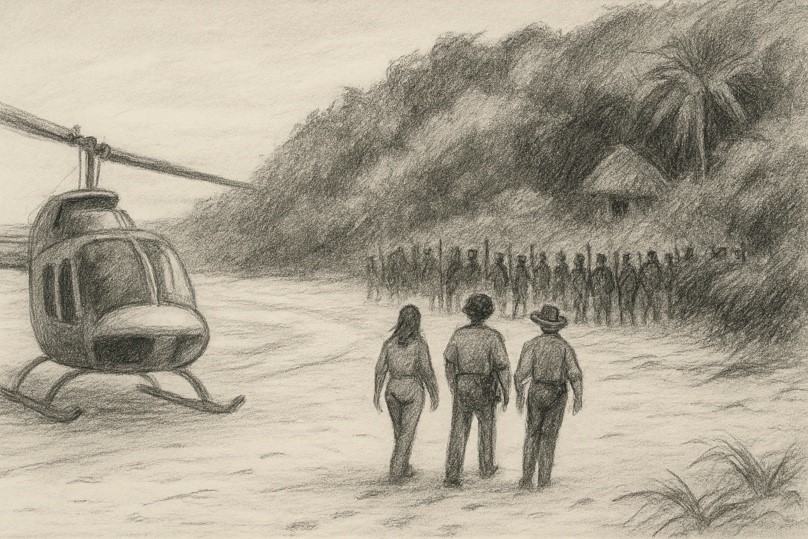
We had a chance to talk – through an interpreter at first, and then more directly, once we discovered their chief spoke English. He’d studied for a time in Honiara. He welcomed us and showed us around the village.
I took photos to show to Terry later.
They were kind. Open. Eager to help. And for me, that was the problem. They felt too friendly. Too trusting. Vulnerable in a way that made me uneasy.
I told them, gently but firmly, that my small team might be tolerable – that, although unlikely, if the larger crew descended on them, it would be different. An ugly scene. We, and the film we were making represented the kind of outside world they’d once pulled away from. The very thing their community had fled decades earlier.
They said they understood. Still, they agreed to host us. Said they’d prepare for our return. They even offered to build small huts for five of us.
A Flight Back, a Favor Asked
I flew to the set in Queensland to meet with Terry and show him what we’d found. There were no second choices – either this was the place, or he’d be forced to build a replica village near Honiara, which would have been costly and, frankly, inauthentic.
Journal
There were no roads to the Moro village. No easy path in. I imagined the only way there was by dangerous boat or to fly around the island by helicopter – below the fog line – just off the coastline, skimming tree canopies. With some help from the bookstore owner, I arranged for a chopper and convinced our reluctant liaison, Robert, to come with me.
The fog was so thick we never would have seen the village from the air if we hadn’t hugged the shore.
But we found it.
He paused a moment. Then said yes.
A Rare Bird Sends Word
I met the crew – two assistants and a welcomed art director – with the cameras lenses, film stock tripods and all. I decided to send Terry the test reel that I’d spoken to him about – women weaving, children swimming, birds in the canopy.
After two days of shooting everywhere, we sent a test reel on a its very dubious journey. But timing and logistics were very much against us.
First by helicopter from our village to Honiara. Then thru Customs and on to Sydney, where the lab was. Then the processed film flon up to the main unit in Queensland. And to a screening room for watching dailies.
That accomplished, we started filming wherever we could. We filmed people fishing, children swimming, birds tracing slow arcs over the river. We listened to the rhythm of the place and tried to follow it. I kept thinking of the images from Days of Heaven, of light doing half the storytelling, and hoped that if we stayed open long enough, something would happen that carried that same quiet truth.
None of us knew if it would arrive on time or even be watched in the end by Terry.
So, we kept filming. Every day, new rolls. Women weaving mats. A boy with a slingshot. The wind through palm leaves that sounded like whispers when played back later. The days blurred together in that humid green light. We began to live by instinct alone—shooting whatever carried a pulse of life.
Days turned into weeks and suddenly we were out of time. Still with no word from Terry.
On our last day of shooting, we were filming the villagers swimming where a river met the sea – children leaping into the water, men gliding on narrow canoes. The light was perfect.
I sensed someone new standing near us. And when I looked up from the camera I saw a young boy standing at the edge of the clearing, watching us. He was barefoot, holding a crumpled piece of paper in his hand.
He’d come from the radio hut.
The note was folded and smudged from travel, passed through too many hands to count. I unfolded it carefully. Inside, a single line:
“Dailies look great.”
That was it. No signature. No details. No direction about lenses or framing or light. Just those three words — somehow enough.
After weeks of silence, it wasn’t what I’d wanted but at this point, it was perfect.
No more. No less.
That was enough.