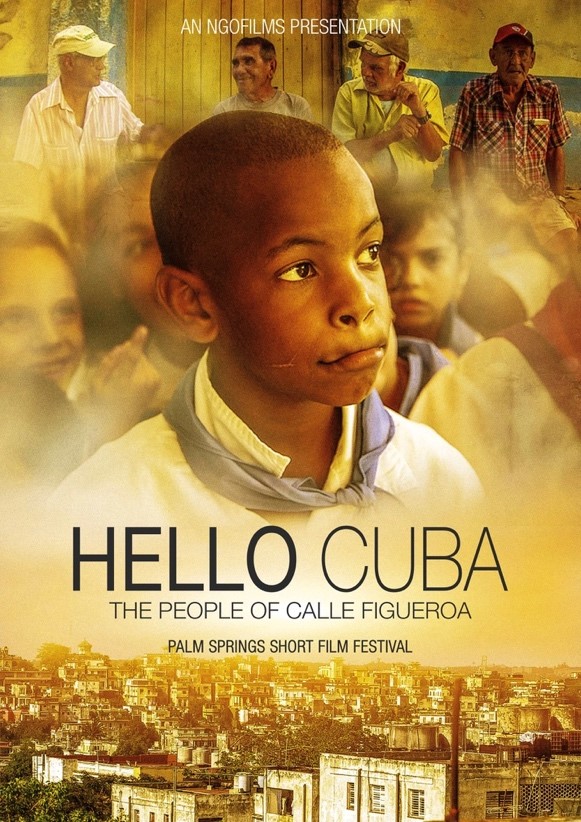
Hello Cuba
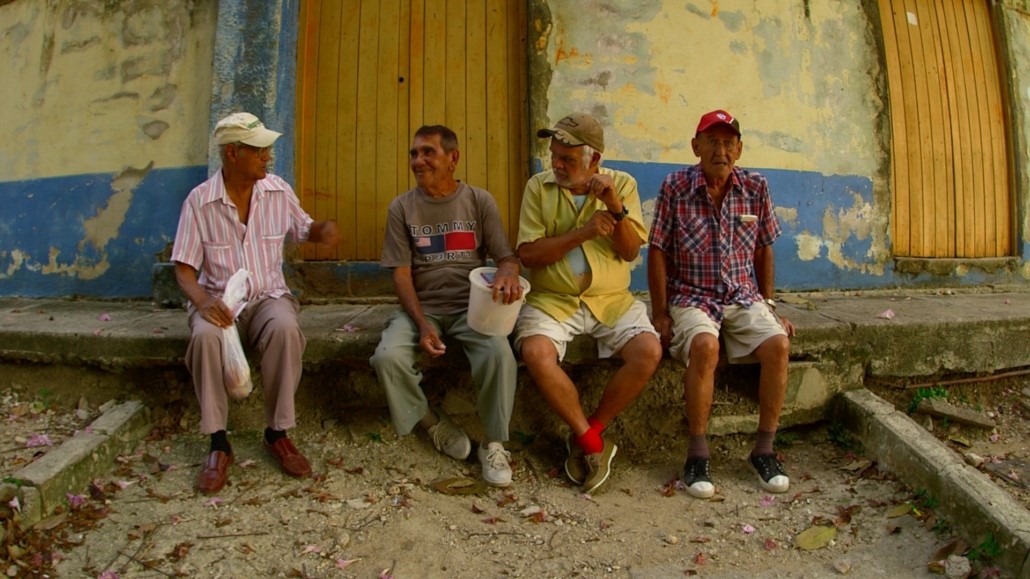
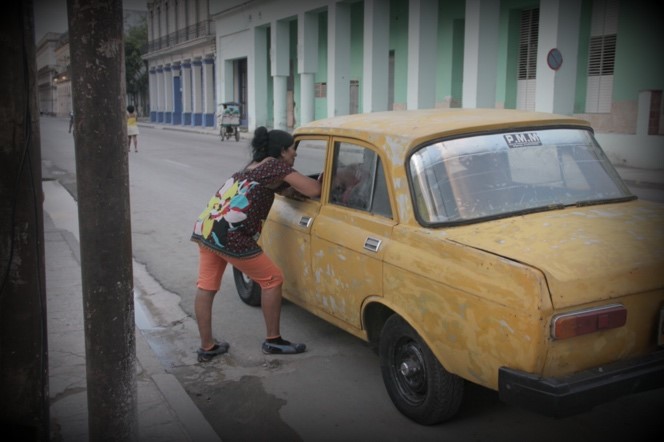
They gathered here every day – to talk, to argue, to laugh. I didn’t know it when I took this photo, but these four men would become central to the film. Their generosity, their insight, and their warmth grounded everything we tried to do. It wasn’t just a street anymore. It was theirs. And, for a time, they let me be part of it.
Ah, Cuba.
I had wanted to go there for what seemed like forever.
Back in the late 1960s, I joined the Peace Corps and was sent to Chile, where I fell in love with the people, the language, the entire Latin American spirit. Since then, I’ve filmed across the continent: returning to Chile more than once, spending long stretches in Peru, forging friendships that outlasted the projects.
Cuba, though – Cuba had always hovered out of reach. The revolution, the myth of Fidel and Che, the mystery. I carried the weight of its history like a rumor I hadn’t yet heard in full.
I wanted seemingly forever to make a film there. A proposal to film along a small street in Havana was what I came up with eventually. But it was to “arty” or just bad timing or politically challenging and it never got funding.
The proposal was seemingly innocent enough:
After six decades of the most enduring trade embargo in modern history much of what life is really like on the small island of Cuba remains a mystery to most Americans. Although each year travel bans are easing, little is known of the day-to-day realities of life on this enigmatic island only 90 miles from our shores. Has the 6-year old socialist experiment been a success or a failure? Opinions vary enormously.
Now we can see for ourselves through the eyes and the lens of one of Cuba’s most famous photographers. Jose A. Figueroa, known as “Figo,” has been a reliable witness of Cuban contemporary history since the 1960’s, making him the only living photographer to cover Cuban life continuously for over five decades. His black and white photography has been exhibited at galleries all over the world
One of the most important lessons I’ve ever learned in documentary filmmaking came quietly, and a little unexpectedly, on that street.
Letting the Story Choose Its Own Guide
I had assumed the photographer José Figueroa would be the perfect center for the film. After all, we were walking along a street – Figueroa Street – that just happened to share his name. No relation, just a coincidence, and the project was his idea to begin with. He thought it might make a good photo series. I thought it might make a good film.
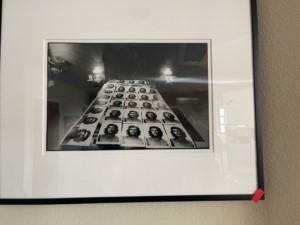
The photograph is Figueroa’s. It captures the iconic portraits of Che drying on his bed—prints he made while working for Alberto Korda. A subtle, almost poetic comment on how images of revolution would later be sold to the world.
But as the days passed, something shifted in me. A growing realization made me reconsider the foundation of how I was telling the Cuba story. I’d built so much around Figueroa’s character.
Back home, editing in my head, I realized that José – extraordinarily talented though he was – wasn’t quite the person to carry the film. His work was quiet, deeply intellectual, and he himself was gentle, reserved. He observed and captured without ever drawing attention.
What I had imagined instead was someone larger than life – a Cuban photographer with a booming laugh, a wild beard, a shoulder-slapper. Someone who told stories as he took pictures, who could pull the people of the street into the frame with warmth and irreverence.
But that man never appeared. And so, after a few slow walks with José up and down Calle Figueroa, I made a choice: I wouldn’t follow the photographer. I’d follow the street itself – and the people who lived along it.
The Street Gives You What It Wants
We parked across from a small park each day about halfway along the 4 blocks that made up Calle Figueroa and hauled our gear back and forth as we needed it. It wasn’t long before a family living nearby – warm, curious, entirely Cuban in their openness – waved us over and offered something simple but golden: “Why not keep your equipment here?” they said. “No need to carry it back to your hotel every day.”
We agreed immediately.
And thus they became, by accident, one of the families we began filming. And then I made one of those well-meaning mistakes you only recognize later.
Inside the house was a piano. I asked who played, and someone pointed to their young daughter. I saw it instantly: the perfect opening to the film.
We’d start with silence, walking down the street with a handheld camera. From somewhere ahead, we’d begin to hear beautiful classical music. The camera would move slowly forward, closer and closer, until we reached this house. A look through the front window would reveal her, playing something exquisite. A quiet, unexpected overture. I thought it was a lovely idea.
I set up lights. We scheduled a recital. But she turned out to be a very average piano player, and the piano itself – heartbreakingly out of tune. The moment was far from cinematic.
But it was real. It was charming. And it made it into the film – just not at the beginning.
Not Every Film Finds Its Audience. Some Just Find You.
Hello Cuba didn’t go far as a film. It made it into a few festivals, but without the kind of publicity push these things often need, it quietly disappeared. No major release, no wide acclaim. Just a small film, made with care, that came and went.
And yet, I still think of it often.
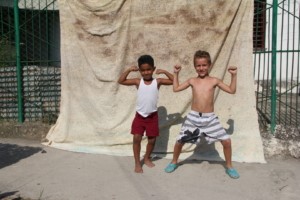
It’s a gentle portrait – of a street, a people, a way of being. It’s full of warmth, wit, resilience. The kind of moments you can’t script: a neighbor calling out across the fence, a boy pretending his bike is a race car, someone holding their gaze just long enough to allow the shot.
I went to Cuba looking for a story. I came back with something quieter. A reminder, maybe, that not every film needs to roar to matter. Some simply live – tucked away on a shelf, flickering quietly, waiting for the right eyes to find them.