First Film
How a no-budget first film, a borrowed camera, and a handful of mistakes became my film school.
One night in the late 1960s, while I was in the Peace Corps, a friend and I were inventing ways to expose someone’s cover if they were a spy. The classic test: ask them, “Who won the 1959 World
Series?” If they couldn’t answer, the theory went, they weren’t real Americans. I always thought thatwas a terrible metric – I couldn’t name two baseball players then or now. By that logic, I’d have been a prime suspect.
We started tossing around our own versions of “spy tests,” joking and brainstorming – until I looked down at my plate and saw it. A better test. A visual one. A small moment hiding in plain sight: an Oreo cookie.
Years later, living in Berkeley while eager to teach myself filmmaking, I came back to that idea.
I decided to make a short film in the form of a TV commercial.
There were no film schools yet. No mentors that I knew. Just a borrowed camera, a quiet idea, and the feeling that maybe this was what I was meant to do.
And then it somehow actually happened.
I found an abandoned building near the Bay to serve as our set. It was half condemned, filled with creaks and shadows. Armed with a borrowed Bolex camera with three interchangeable lenses, a group of willing friends, and a few props, we set out.
I shot far too many scenes that day – enough for a short film and then some. But I learned more in that one day than I might’ve learned in a year of film school.
The truth is, I had no real idea of what I was doing. But something felt electric about holding that camera and embracing the challenges. I loved how my friends showed up and played along. Even our location seemed to join in, offering its nooks and crannies and the way light just happened to fall – as if it wanted to be part of the story too.
Here, is the script, reversed engineered after the fact. Images are lifted from the finished 16mm film.
Oreo Commercial
FADE IN:
EXT. ABANDONED WAREHOUSE – NIGHT
Tall weeds sway in the wind. The moonlight casts jagged shadows across rusted sheet metal. The place hums with menace.
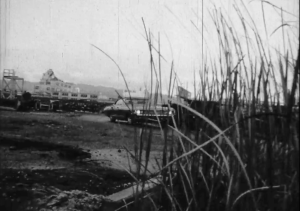
INT. WAREHOUSE – CONTINUOUS
A BLINDFOLDED MAN is led inside by TWO TRENCH-COATED FIGURES. Their footsteps echo on concrete. They guide him up a SPIRAL STAIRCASE.
INT. INTERROGATION ROOM – MOMENTS LATER
A blinding SPOTLIGHT flares on. Hands rip off the blindfold. The man squints. He’s clearly disoriented.
INTERROGATOR #1 waves a PASSPORT in front of his face.
INTERROGATOR #1
Raised in Milwaukee, huh?
The man says nothing.
INTERROGATOR #2
How would you eat one of these, American?
He holds up an OREO COOKIE. The prisoner looks baffled. He doesn’t answer.
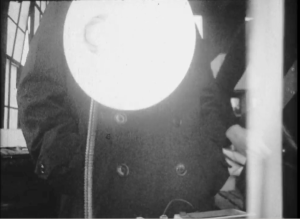
A mysterious WOMAN enters, dressed sharply, carrying a BRIEFCASE.
She places it on the table. Click. Click. It opens — to reveal a FULL PACKAGE OF OREO COOKIES. She steps back into the shadows.
The prisoner stares. Slowly, he reaches for one… bites down like a sandwich.
INTERROGATOR #1
Spy!
INTERROGATOR #2
Get him out of here!
The trench coats seize him and drag him away.
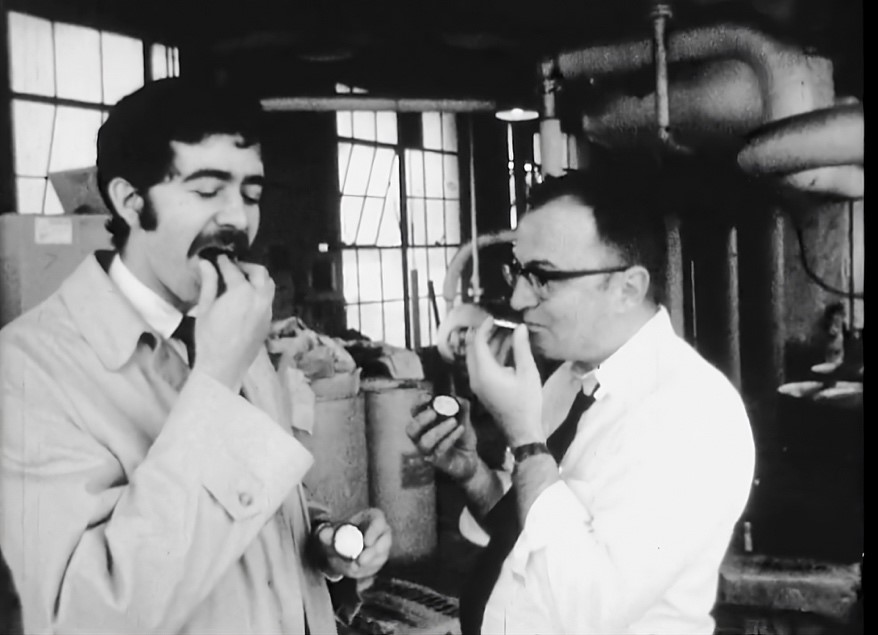
The two interrogators pause. Then, curiously, each picks up a cookie. Twist. Lick.
FREEZE FRAME: Their faces, mid-lick, eyes closed in bliss.
NARRATOR (V.O.)
Any real American knows how to eat an Oreo cookie.
CHORUS (O.S.)
Oorrrreeeoooo…
FADE OUT.
Boy, was I excited to see the developed film. Shockingly, the rolls came back with an inadvertent streak of light along the edge of the frame, caused by a missing small slide-in filter that fits behind the lens. I couldn’t fix the streak, so I learned to cut around it and live with it. When those shots were used, they gave the film a unique look—my first lesson in happy accidents. And my first real lesson chalked up to do-it-yourself film school: always put that filter thing in the Bolex.
The truth: I had no idea what I was doing that day. But something felt electric about holding that camera and embracing the challenges. I loved how my friends showed up and played along. I was lucky that there was electricity at all where we filmed but I had to rig lighting with extension cords snaked through holes in the wall. The building was half-condemned, filled with creaks and shadows. My girlfriend—dressed like a noir assassin. We all winged it.
Those, along with dozens more important lessons were learned that day. Learned by taking a risk. When the film came back with that streak of light burned in, I was crushed. But after watching it a dozen times projected on my living room wall, the look grew on me. That slit became a kind of scar—a mark of the moment.
A friend from Zoetrope Studio helped me edit it together over a few nights.
Later, another friend mentioned knowing someone at Nabisco’s ad agency. Ever naively hopeful, we mailed them a copy of the film, thinking they might love it and surely hire us to shoot a real commercial for them. Of course, we never heard back: an important lesson learned. And every time I see someone twist an Oreo the “right” way, I can’t help but smile and think, “Maybe, just maybe, that was our idea first.”
That film, with its unintended light streak, became more than just my first real project – it became the spark that ignited a lifelong journey. A simple idea, a borrowed camera, and a group of friends – the beginning of the beginning.
Lessons from a First Film
1. Start Before You’re Ready There were no film schools yet. So, no formal training. But the urge to create was enough. This is the first and perhaps most enduring lesson: don’t wait to be “qualified.” Begin.
2. Ideas Can Be Found Anywhere—Even on Your Dinner Plate. The concept came not from a script meeting or research—just a playful conversation and a glance at an Oreo. Creativity often hides in plain sight.
3. The Best Film School Might Be a Ruined Warehouse A borrowed camera, a half-condemned building, a few friends—sometimes all you need is access, curiosity, and a little nerve.
4. Embrace the Do-It-Yourself Struggle. From running extension cords through crumbling walls to improvising lighting and sound, these first struggles teach you far more than a classroom ever could.
5. Technical Mistakes Can Become Visual Signatures. The missing Bolex filter caused a light streak you couldn’t fix. Instead of scrapping the footage, you edited around it—and eventually saw it as a strength. Mistakes can become style.
6. Learn By Doing—And Failing. I had no idea what you were doing. That’s the point. The camera, the chaos, the improvisation—that’s how learning takes root.
7. Cast Willing Friends. Your friends didn’t just show up—they inhabited the film’s spirit. Early collaborators are more than actors; they’re fellow believers in your vision.
8. Every Frame is a Time Capsule. The streak in the film became a scar, a mark of the moment. What felt like a flaw turned into a memory—proof that you showed up, tried something bold, and captured it.
9. Humor Is a Bridge. The Oreo “Spy Test” wasn’t just absurd—it was cinematic, culturally specific, and hilarious. Humor creates connection. It also lowers the stakes, which is vital when you’re learning.
10. Film is a Faith-Based Medium. I believed in something that didn’t yet exist. That’s filmmaking: a leap into the unknown, often armed with nothing but instinct and hope.
(add a video link to a short lift from the Oreo commercia?l)