The Tiwah of Borneo: Celebrating Death:
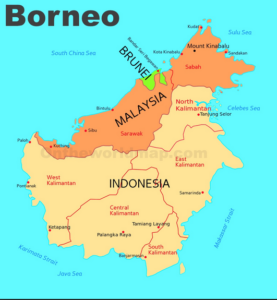
Borneo is in Southeast Asia and is the third largest island in the world. It is politically divided between Indonesia, Malaysia and is surrounded by exotically named places like Sumatra, Bali, Sulawesi, and Java. Largely due to the remoteness of where it is practiced, in Central Kalimantan province, few outsiders have ever heard of a Tiwah and even fewer can claim to have seen one or come away understanding it.
A Loss at Home
The timing of the project made personal sense to me. I had recently lost my dear father who was 95.
Different cultures see dying differently. We may have attended funerals, sent flowers, signed condolence cards. We’ve watched films, read books, overheard grief in the lives of others. We’ve brushed up against loss but largely at a distance before it hits home. Then one day, it’s our turn. Someone close to us dies. And we find ourselves in unfamiliar territory, unsure how to mourn, how to make sense of what’s been taken.
The Tiwah : Celebrating Death
I don’t need it to be provable. I have a space inside me that wants to believe that there are invisible forces at work – behind the scenes if you will – that we don’t comprehend. At minimum, I’m drawn to rituals and people who act as if it’s real for them.
The Tiwah is a somber and joyous week-long celebration in Borneo with ritualistic ceremonies all day and night, lots of chanting, music and dancing, fire and smoke, ritual baths, trances, mock battles. There were sacrifices of cows and chickens, and lots of great food – all designed to honor and please the ancestral spirits whose job it is to guide the dead on their final journey. And, did I mention the drums? Lots of drums. Oh, and gongs too.
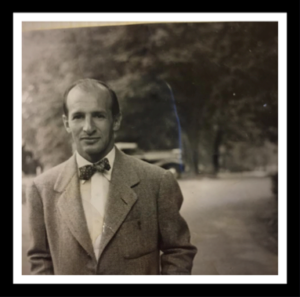
In late 1995, I was working on a film in Israel when word arrived that my father had suddenly passed away. He was what seemed like a strong 95-year-old, so I was in shock, convinced he’d outlive me. I returned immediately to Washington, D.C., where my family shared a house with him on Macomb Street in Cleveland Park. Much of what happened during the following two weeks remains a blur.
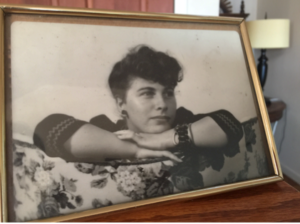
My mother died almost thirty years prior to my father’s death. She took her own life: a fact I didn’t see coming and that wasn’t discussed after it happened. The news threw me into shock, followed by a similar blur to the one following the death of my father.
Anne Schiller and the Dayak
Our film for National Geographic was to follow Anne Schiller, an American anthropologist who had worked for years among the Dayak people. The Tiwah was part of her focus about which she had become a kind of expert.
Tiwah is the name given to this weeks-long community-wide festival for the dead carried out by families of the departed to bless their loved ones and the larger Dayak community. It’s a mix of animism, ancestor worship, and Hindu-influenced rites. Imagine Halloween, only on hallucinogens. And with far better costAs with Halloween, it’s believed the spirits of the dead are nearby. But here, the goal isn’t candy. It’s to help the soul of the departed find a clear path to its final place in the spirit world they call Lewu Ttau. The responsibility lies with the living and the Tiwah is the ritual required by the family members to help them get there.
There was a little bit of something for everyone in the Tiwah.
Our Funerals, Their Funerals
My father’s funeral was neat and sensible. Everything was as you would expect, proper, brief and over by lunchtime. No chickens were sacrificed. No gongs. No dancing. Just the hum of polite grief and the vague feeling that we’d all followed a script someone had written long before we were born.
Participation in Tiwah wasn’t just a choice the way we understand choices in our culture: it’s a requirement. As Anne explained to us, “On our side of the world, it’s believed by many that getting into heaven is based on one’s own merit. If you were good: you get in. If you weren’t so good, you don’t.” In Dayak culture, it’s believed that the only way you get there is if your children perform this weeks-long ritual for you.
Part of the tradition includes burying the dead twice.
It goes like this. When someone in the community dies, their family buries them temporarily in the ground where they are kept in a kind of holding pattern until the community as a whole can perform a Tiwah. Prayers and songs accompany this temporary burial, designed to protect the souls of the dead while they wait under the earth.
The idea is that when enough people have died in the community since the previous Tiwah, and when enough money has been raised collectively by the community to afford it, the village headman will announce and schedule a Tiwah. But, alas, the waiting time for the next Tiwah can sometimes take years before a Tiwah is called. Sometimes decades.
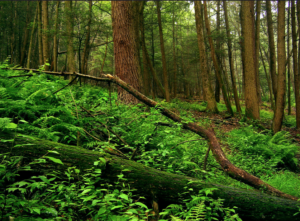
Once a Tiwah begins, the first step requires that families locate and unearth their loved ones waiting patiently in the ground. The locations of the graves in the rainforest are often chosen spontaneously at the time of death and are often poorly marked. If years have passed, the forest floor will be deeply covered in thick growth covering previous trails and making the burial spots almost impossible to locate.
The first day that we arrived in the village, we found ourselves bounding thru the jungle trying to keep up with eight members of a family searching for the temporary grave for a man named Belawan who had died five or six years earlier. At first, the family seemed sure that they knew just where the grave was located, so I wasn’t prepared for what happened.
Alas, there was no grave where they originally thought Belawan might be buried, and, as each new spot proved not to be right either, we all became increasingly concerned that Belawan might never be found. We chased around for more than two hours, passing other family groups trying to locate their own loved ones’ burial sites.
At one point, we found ourselves grouped in a circle, surrounded by heavy vegetation with only the sounds of insects, distant chanting, and our own heavy breathing. I wondered if the spirits were watching our folly from above and looking down at us disapprovingly. Or, were they laughing? Suddenly, a shout rang out and we all knew instantly that someone had located our Belawan.
No treatment could have predicted that our first hours in the village would be spent lost in the jungle, chasing half-remembered paths to a grave that might not even be there. Yet this was the truth of the Tiwah: that memory falters, that grief is messy, and that the living must search hard to keep the dead close.
Stories, Laughter, and Bones in Hand
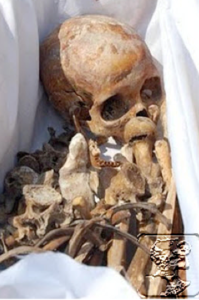
Discovering the grave proved to be quite moving for everyone — including me. After a few strokes of the shovels, and to everyone’s relief, we found ourselves face-to-face with Belawan’s remains. I’m not sure what I was expecting, but I wasn’t prepared for there to be an actual skeleton in there. In our culture, we don’t stumble across a lot of human skeletons in our average daily travels. What little remained of Belawan’s clothes were in tatters, almost nonexistent. His bones were encrusted with dirt and plant roots.
As they slowly lifted his bones now scattered and disconnected out of his earthly grave, they passed them carefully around for everyone to examine. More mixed tears of sadness and joy.
What came next was another surprise. It seemed that a few personal possessions belonging to Belawan were typically added into the grave at the time of the first burial — objects that were meaningful to the deceased — like photos of them with family members or maybe a piece of jewelry. Each object, upon discovery, inspired memories and lots of stories. At one point, a well-worn kitchen pot was dusted off and lifted out of the grave encouraging Belawan’s younger brother to tell a story about Belawan’s love for cooking. More tears. I could tell his was a humorous story that all enjoyed hearing. My father loved to tell jokes and enjoyed watching when people laughed at them.
I would have thought that the memories of their loved one would bring sadness and feelings of loss. But this unveiling of sorts clearly inspired stories and laugher. Having the bones of your dear sister or husband or father in your hands was certainly something uncommon in our part of the world. Watching them being passed around this intimate circle seemed perfectly normal. I loved Belawan’s family.
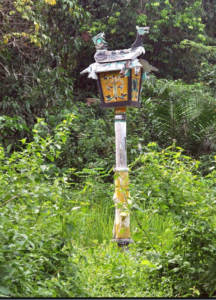
While this was happening, a few family members carefully gathered all the bones, lovingly cleaned them and placed them into a wooden box designed for the purpose. Over the next few days, the bones would be prayed over, washed, cleaned more, dusted with baby powder and eventually placed in a much larger bone repository called a Sandung. Eventually, Belawan’s bones would be joined with his ancestors’ in a large above-the-ground beautifully painted Sandung at the culmination of the Tiwah.
Many western families might have family plots where everyone would be buried side-by-side, but this Dayak idea of putting all the bones together in a large collective box resembling a house with windows and doors took the notion of being together to a new level.
My father was the youngest of five sisters. Years earlier, the family had arranged a burial plot in Los Angeles where they would all be laid to rest together. At one of the earlier funerals, one of his sisters — always the sharp one — looked around and said, only half-joking, “Last one in is a rotten egg.”
When my father died, he was, in fact, the last one in. I couldn’t get that line out of my head.
Toward the Prosperous Village
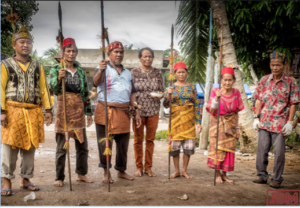
In the Dayak vision of the afterlife, all the ancestors reunite in a place they call the Prosperous Village. There, they fish together, herd livestock and they hold more feasts and celebrations. But in order for them to all join together in the Prosperous Village in the first place, surviving family members back on the earthly plain must cooperate together to make it happen. That’s Tiwah.
Without the community’s efforts, the souls of their departed would not make it to the Prosperous Village where “the rivers are filled with fish and no one goes hungry.”
Because family members are responsible in this way, there is an unbreakable link between living and dead that continues to bind generations together. Anne suggested that the importance of the Tiwah to the Dayak culture has encouraged families to stay unusually close to each other thru generations in life as well as in death.
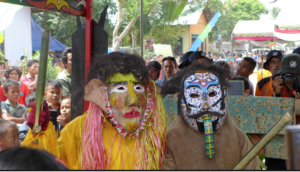
What was it about this event that was so moving to me? Surely not the animal sacrifices. Nor the way those gods seemed to enjoy spicy food. (Not my thing.) But being there to observe the event gave me a rare window through which to observe a wonderfully human and generous tradition. Surrounded by the amazing dancing and drumming and incense and chanting and watching priests go into trances and lots of people in masks, I felt strangely at home.
The experience of mourning seems to be largely a universal one among humans and some animals too. The Tiwah is just one of many rituals like it among cultures around the world that connect us to our departed loved ones. At home, we might light candles to honor the anniversary of someone’s death. The Vietnamese celebrate Tet each year and, as with the celebration of the Day of the Dead in Mexico, generations of departed loved ones are honored. It is as if a veil is lifted and we can reach across the gap to commune with loved ones who have departed from our world.
The notion that we are all connected in ways that we will never know or fully understand is not unique to the beliefs of the Dayak people. And while our western traditions might not go as far as theirs, something magical is surely in the air amid the wispy incense, the chanting, and the music.
National Geographic and the Ratings Game
I was originally asked to direct the Tiwah film. The head of television at National Geographic liked my take, liked my energy. Then, just before we were set to leave for the shoot, he decided he liked it so much, he announced with a touch of chagrin that he’d direct it himself — despite never having directed a film before. He asked for my support. Awkward.
So I became the cameraman with opinions. Most of what I’d imagined quietly evaporated. He was especially eager to bring up cannibalism, hoping it might bump the ratings. It felt familiar — like the Korowai film all over again. The real story was right in front of us, but somehow we kept reaching for the headline instead.
Animal sacrifices were performed during the week. I decided to film this part of the Tiwah with my camera set to shoot at six frames per second instead of the usual 24, making the images appear blurry and more visually abstract. The result was that the killing and blood were easier on the eyes of an audience watching on the other side of the world
The film that National Geographic put together in the editing room was mostly disappointing. It leaned hard into the strangeness of the whole event and, in my opinion, missed its real beauty by focusing more on the peculiar aspects. The producer kept trying to get Anne to talk about cannibalism and human sacrifice. She kept refusing to respond while we looked down at our feet.
The first reaction — maybe even the lasting one — to a Tiwah can easily be: this is strange. But instead of moving beyond that, the film leaned in. Dropping a line about cannibalism right before cutting to commercial break was strategically placed to keep people from changing the channel. It was television logic: earn the ratings, earn the points.
I began to distance myself from National Geographic during those years as the stories started getting reshaped — steered more by what might increase viewership than by what actually happened. Things steadily got more dramatic. The soundtracks as well. I don’t blame them entirely; the media landscape was changing, cable TV was growing, and they were under pressure to keep their audience. But I saw what that pressure did to stories like the Tiwah. And I didn’t want to be part of it.
The craft of making documentary films was changing.
New York Magazine ran a plug for the film that said it all:
Borneo: Beyond the Grave sends red-haired anthropologist Ann Schiller
to deepest Indonesia, where she will be adopted into the Ngaju Dayak
tribe of ex-headhunters and participate in reburial rituals that involve
grave robbing, skull-scouring, bloodsucking, animal sacrifice, honeybees,
masks and drums. You’ll like her.
Smoke, Prayer, and My Father
Meanwhile, in quieter moments, Anne spoke to me with real reverence for the Tiwah. The beauty of it. The dignity.
Being around those rituals helped me process my own father’s recent death — something I hadn’t really done. The Tiwah gave me space to feel it.
Is there a Prosperous Village somewhere, as the Dayak believe, where all our mothers and fathers are sitting around talking or playing cards or golf? I don’t know. Hard to picture. But being surrounded by people who believed it — and acted like it — was surprisingly comforting.
At certain moments during filming, I felt a real connection to my father. A bit of incense smoke drifting sideways. The sound of morning prayer. Even now, those moments stay with me. I brought out old family photos, placed them around the house. And sometimes, the light in our dining room brings them back to me – the same way a song or a dream might.
A Quiet, Lasting Effect
I’ll never forget watching Belawan’s family gently clean his bones, rub them with powder. It was the most intimate, human part of the whole ceremony. And my camerawork on that film may be the best I’ve done. Borneo brought together the right mix of forces — physical, emotional, maybe something more.
Tiwah had a quiet, lasting effect on me. I felt connected to the Dayak people, to their losses, to their respect for the departed, their belief in what lies beyond what we can see. It’s rich, complex, deeply human.
Anne said it best: “Whenever I leave this place, I come away with a heightened sense of awareness about my family and my community — and how very interdependent we are, and how we really do need to take care of one another.”
(That experience shaped the way I witnessed the Tiwah — a ceremony that might otherwise have seemed distant or strange.
Because I was already carrying my own grief, I could feel something deeper beneath the surface of what we were filming. It helped me recognize what couldn’t be translated — the quiet weight of what these families were going through.)