THE SHOT I’LL NEVER FORGET
In November of 1982, Washington, D.C. held a week-long celebration to honor Vietnam veterans. I was still living there, and when a friend of mine—filmmaker Foster Wiley—decided to make a film about it, a small crew of us volunteered to help. We were all locals. No one was getting paid. But we knew it mattered.
Carrying Contradictions
I had been against the war, deeply so. And that shaped a lot of who I became—quiet decisions, private stands, people I moved toward and away from. When it finally ended, the country didn’t heal. It turned its shame on the soldiers. Kids who had been drafted came home and were met not with gratitude, but with silence. Or worse.
So when the city announced this week of remembrance—welcoming back the same people we had once rejected—it touched something deep inside me.
They Drifted In
And then they started to arrive.
Not in parades or processions, not yet. They came in quietly in twos and threes. Drifting into town like ghosts. You’d see them on benches near the Mall or leaning against lampposts, wearing old fatigues that hadn’t seen a washing machine in years. Long hair, unshaven, boots still dusty—as if they’d walked straight out of the jungle. They looked… frozen in time. As if the war had ended for the rest of us, but they’d been stuck somewhere just outside of time.
I carried my camera around the city that week, filming whatever I could. But there was one moment—one shot—I’ll never forget.
A Scar in the Earth
The week culminated in the dedication of the Vietnam Veterans Memorial.
A design competition had been held, and after much controversy, it had been awarded to a young Yale student, Maya Lin. Her proposal was stark and beautiful: a long, black granite wall engraved with the names of every soldier who had died. The wall cuts into the earth like a scar—descending gradually as you walk, pulling you into its gravity.
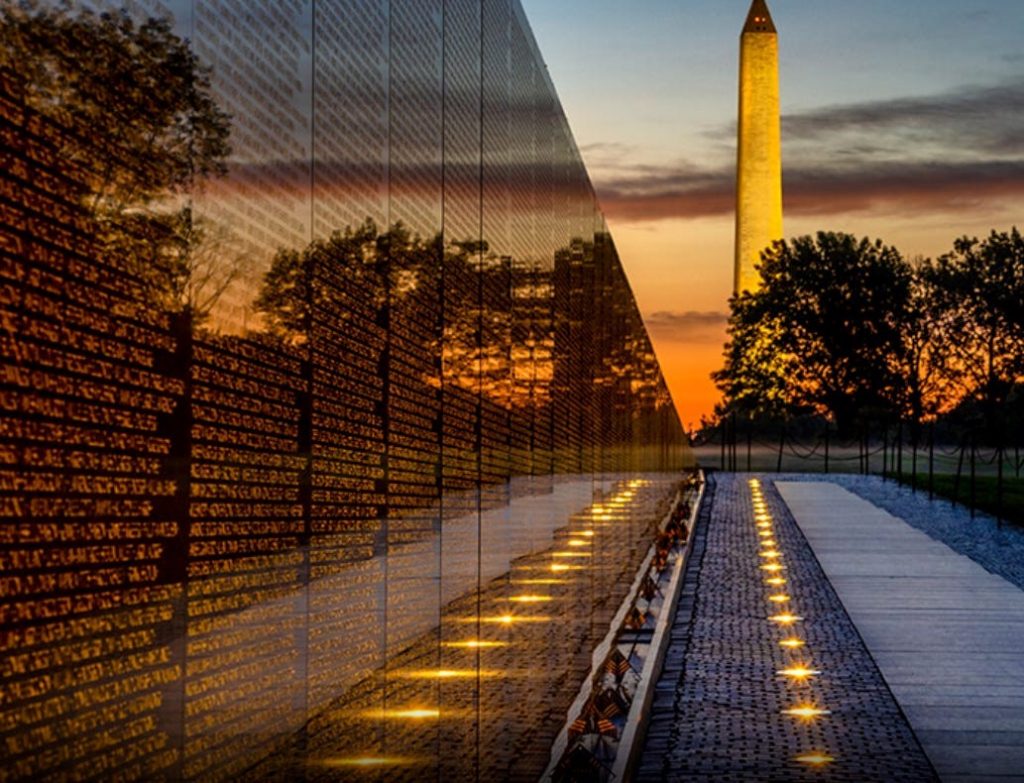
Even the design—like the war itself—divided people. Some thought it too somber, too abstract, not heroic enough. But that was the point. It wasn’t about victory. It was about absence. It asked you to remember, not to cheer.
Vangelis in the Air
On the day of the dedication, thousands came. The National Mall was filled with people—veterans, families, schoolchildren, politicians. Flags waved. Speeches crackled from distant speakers. But what I remember most was the music: Vangelis’s theme from Chariots of Fire, playing on repeat through the loudspeakers. Slow, sweeping, emotional. It floated over the crowd like a memory you couldn’t shake. It didn’t demand attention—it soaked into everything, looping again and again as people moved, waited, wept.
The Shot
I moved through the crowd with my camera, elbowing forward until I had a clear view of the wall.
And that’s when I/we saw each other.
While the Chariots of Fire theme played on, I panned left to right along the top of the wall. Hundreds of vets were up there, some kneeling quietly, reaching to touch the names.
I paused on one man. Like so many others, his hand was pressed flat against the granite. Then he looked up—with a piercing stare directly at me.
Our eyes locked. Even through the lens, I felt it. What I saw was hard to name. Recognition? Forgiveness? Whatever it was, I received it.
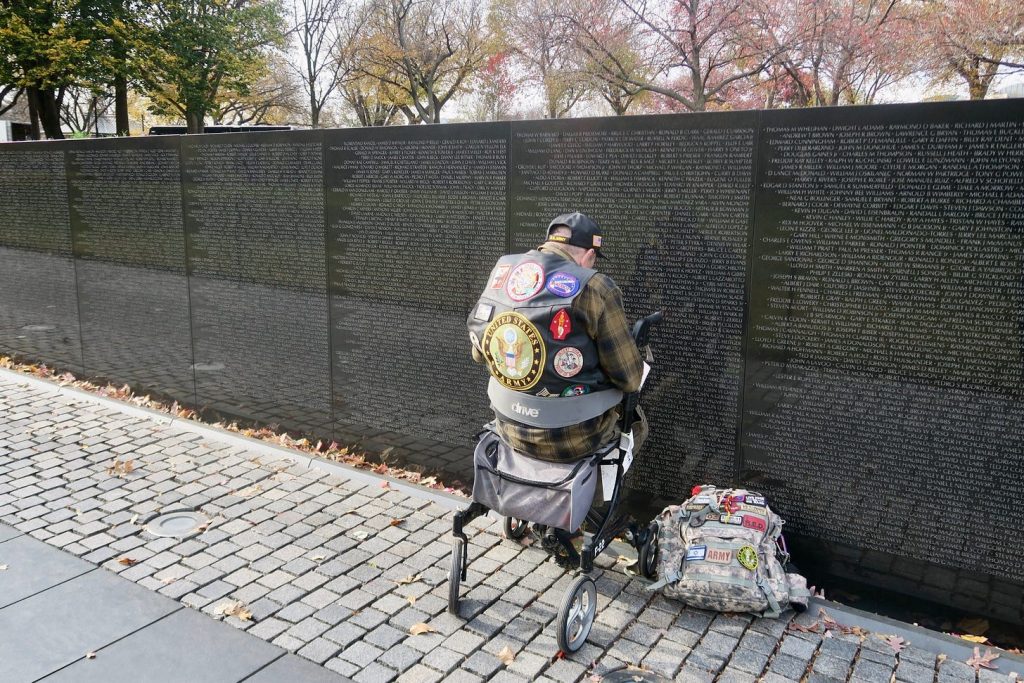
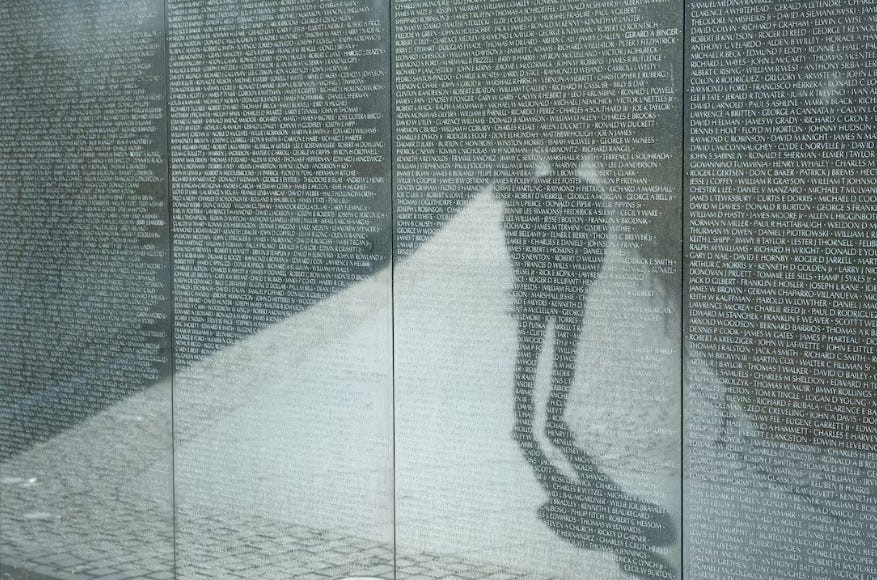
Tears began to roll down my face while I was still filming. At some point, I couldn’t even see what I was capturing anymore. That’s when I lowered the camera.
Neither of us looked away.
Two Kinds of Grief
For a long moment, we stared at each other. I don’t know exactly what passed between us. But it felt like understanding. Like he was telling me: I know who you were. I know you were against the war. But you’re here now. And that’s enough.
He kept looking at me. And in that quiet, suspended moment—just the two of us, a veteran and an anti-war filmmaker—something softened. We were no longer on opposite sides. Just two men at the wall, carrying different kinds of grief.
And then the crowd pressed in again. The music swelled. The spell broke.
But I’ve never forgotten that look. That moment. That shot.